
NVIDIA Open Source Tools Accelerate Development of AI-Driven 6G Wireless Networks
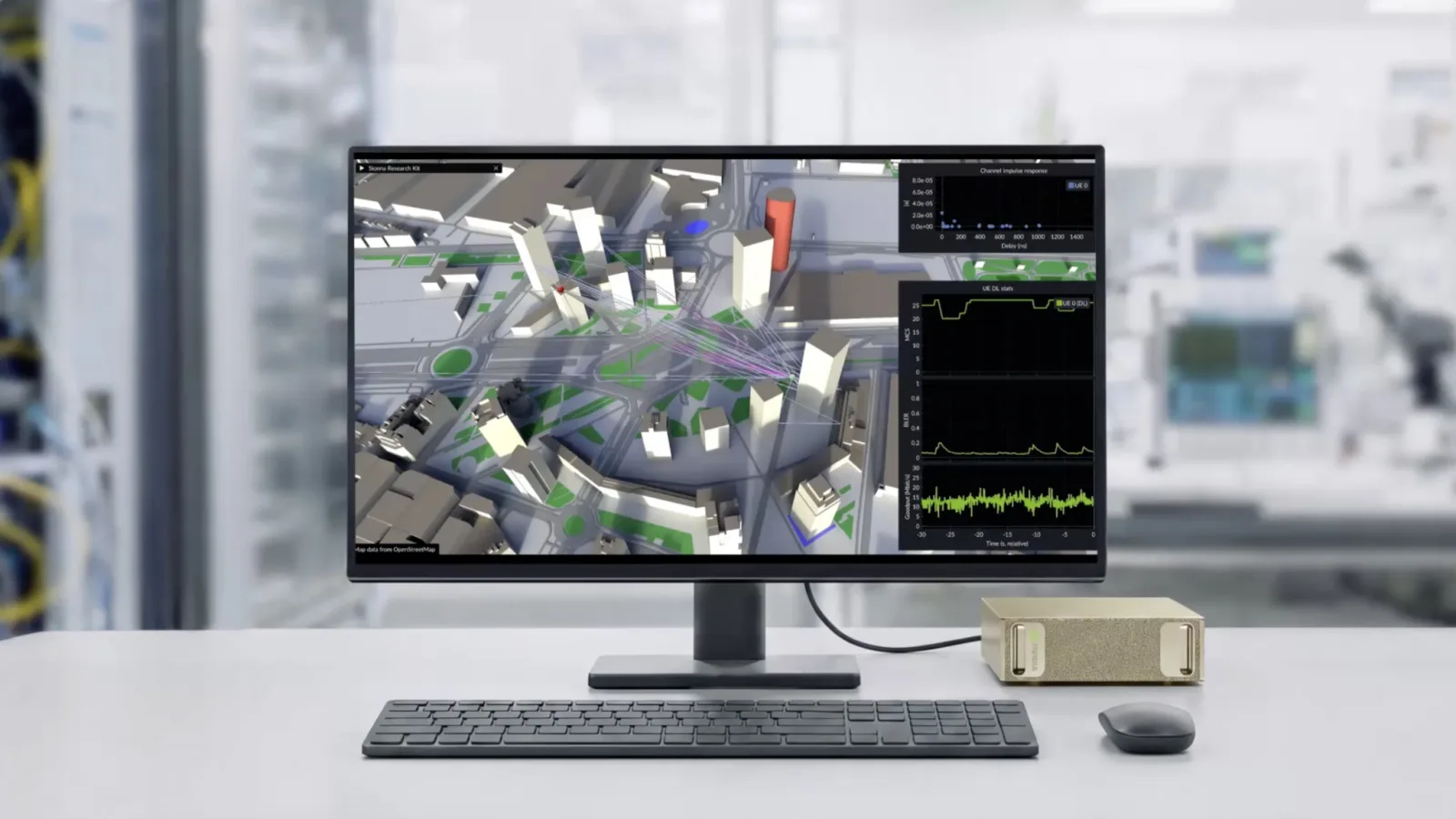
Image: NVIDIA · Source
NVIDIA's open source wireless software and toolkits, including Aerial and Sionna, are enabling researchers worldwide to build and simulate AI-native 6G networks with improved signal processing, energy efficiency, and robotic responsiveness.
A year after open sourcing its Aerial wireless software, NVIDIA is empowering researchers and developers globally to accelerate the design and testing of next-generation 6G networks. Building on the foundation of its AI Aerial suite and the Sionna open source library, these tools unify wireless simulation, AI training, and real-world experimentation within a cohesive software ecosystem.
The NVIDIA AI Aerial and Sionna platforms have seen rapid adoption, with over one million downloads and use by more than 8,000 academic and research institutions worldwide. Together, they provide a foundation for developing 6G networks that extend beyond data transmission to include advanced signal reception, energy management, robotics control, and adaptive connectivity.
One research initiative at King’s College London used NVIDIA Sionna and NVIDIA Jetson AGX Orin hardware to connect a camera-equipped robot arm with software-defined 5G and edge AI capabilities. By transmitting compact semantic descriptions rather than full images, the system reduced task completion times by over 50% and improved success rates in object manipulation tasks. This goal-oriented semantic communication approach enables robots to react swiftly and reliably in dynamic environments.
In another example, SoftBank integrated a neural AI receiver with NVIDIA’s CUDA-Accelerated RAN (ACAR) to improve 5G signal reception. Testing with commercial 5G smartphones under interference showed uplink throughput gains up to 60% compared to conventional receivers. ETH Zurich researchers also used NVIDIA’s tools to fine-tune neural receivers based on local radio conditions, significantly lowering error rates.
Energy efficiency is a critical focus area as 6G connects billions of devices. University of Leeds researchers developed a predictive AI system to dynamically power down and activate base stations based on network demand forecasts, reducing RAN power consumption by nearly 46% without interrupting connectivity. Their tests leveraged NVIDIA DGX Spark platforms alongside digital twins for real-time validation.
To enable faster innovation cycles, the Centre Tecnològic de Telecomunicacions de Catalunya integrated GPU-accelerated radio channel models—running on NVIDIA ACAR—into their open source 5G-LENA network simulator. This reduced complex simulation runtimes from hours to under 20 minutes, allowing researchers to evaluate more designs and scenarios efficiently.
NVIDIA’s open source wireless software components, including Aerial CUDA-Accelerated RAN and the modular Python-based Sionna library, provide highly optimized building blocks for 5G and emerging 6G research. By linking sophisticated simulations, AI-driven signal processing, and practical deployments, these tools catalyze the development of intelligent, adaptive wireless networks designed to serve billions of people, machines, and autonomous systems.
Developers and researchers can access these platforms on GitHub and participate in NVIDIA’s 6G Developer Program for events and training sessions focused on AI-native wireless network innovation.
Sources and original reporting
Read the original source ↗
Comments (0)
No comments yet. Start the discussion.
Write a comment
Comments are published after moderation. Your name and comment will be visible publicly. Account