
NVIDIA Empowers AI Agents to Revolutionize Search for Extraterrestrial Signals
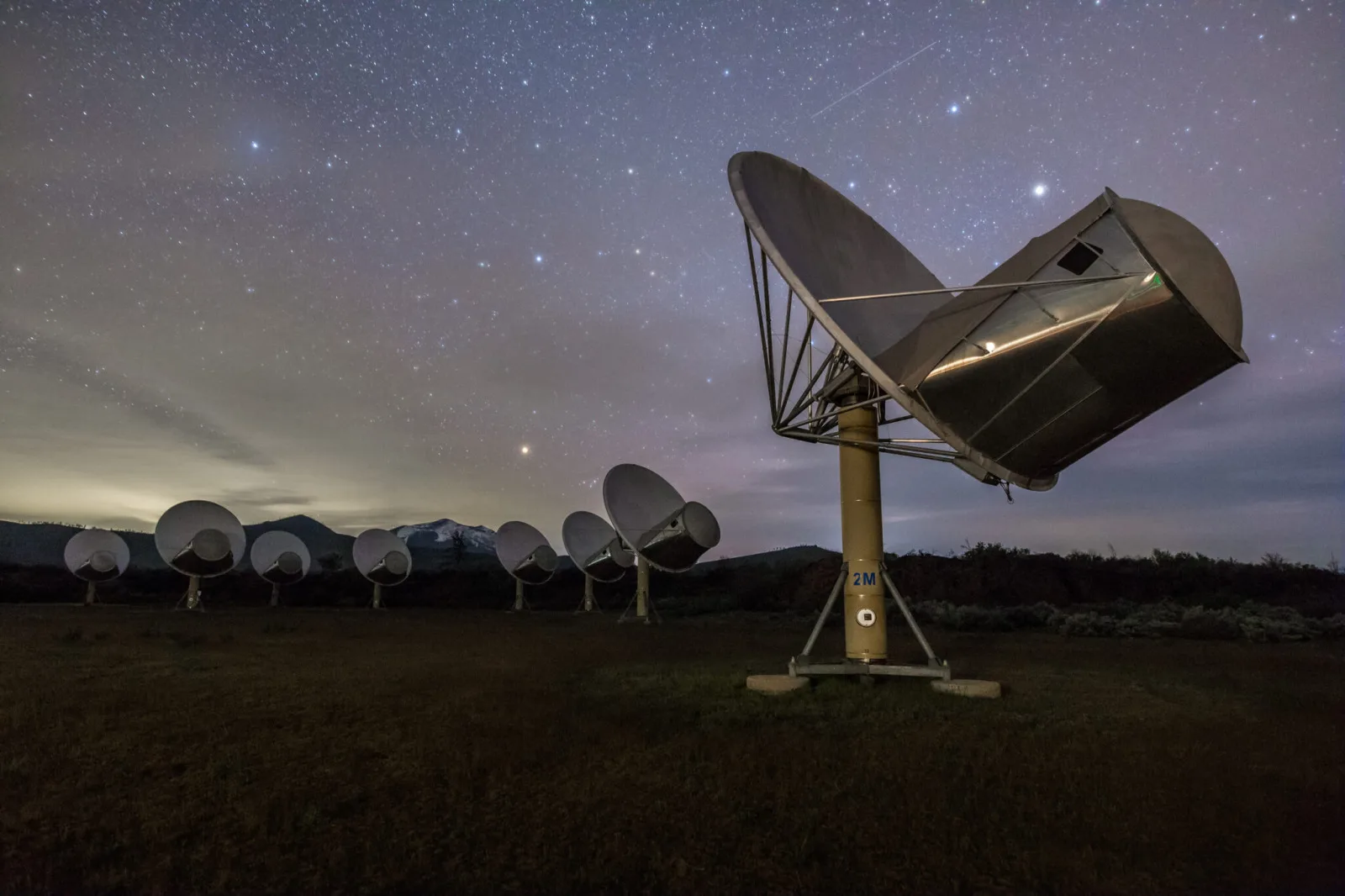
Image: NVIDIA · Source
NVIDIA collaborates with SETI and Breakthrough Listen to deploy agentic AI for real-time processing and analysis of vast radio telescope data, accelerating the hunt for signals from potential extraterrestrial technologies.
The search for extraterrestrial intelligence (SETI) has entered a transformative new phase with the integration of advanced artificial intelligence technologies developed by NVIDIA. Recognizing that any extraterrestrial civilization could be far more technologically advanced, potentially employing their own forms of AI, scientists are now turning to AI agents to aid in detecting signals from alien intelligences.
At the forefront of this innovation is a collaboration involving the Breakthrough Listen project and the SETI Institute, working with the Allen Telescope Array in Northern California. Here, AI agents powered by NVIDIA’s Holoscan platform manage the enormous data flow generated by the radio telescope. These artificially intelligent agents can steer the telescope’s antennae, clean and calibrate incoming data, and apply specialized AI models—all via straightforward natural language commands.
The system addresses a critical challenge: radio telescopes produce terabits of sensor data every second, making real-time analysis daunting. NVIDIA’s DAQIRI library streams this massive influx directly into GPU memory for immediate processing, bypassing slower disk storage. CyberEther, a signal-processing framework from the SETI Institute, utilizes NVIDIA’s CUDA-X libraries to perform complex computations on incoming data.
Controlling this setup is Nexus, a web-based observatory orchestrator that acts as the AI agents’ command center. Nexus consolidates telemetry on instrument status, computational resources, and data pipelines, allowing both autonomous AI operation and researcher oversight. It enables monitoring of packet loss, visualization through live spectrograms, and dynamic rewriting of signal-processing protocols—all prompted through natural language input.
Together, this architecture enables AI agents to compress months or years of observational data analysis into mere hours. Demonstrating its potential, the system recently achieved the first real-time AI detection of a pulsar in the Crab Nebula, highlighting both its speed and sensitivity.
Looking ahead, the team is exploring open AI models such as NVIDIA Nemotron to further optimize data locality and responsiveness. There are even ambitions to deploy similar autonomous observatories on the far side of the moon, where terrestrial communication is limited.
According to Andrew Siemion, Chair for SETI at the SETI Institute and principal investigator of Breakthrough Listen, "As our new agentic observatories reach out into the universe, what they find may have much more in common with themselves than with the humans who created them. But this isn’t something to fear. Rather, it’s a breakthrough in translation."
This partnership underscores a remarkable leap forward in both AI application and astrobiology, bringing humanity closer than ever to potentially identifying intelligent life beyond Earth.
Sources and original reporting
Read the original source ↗
Comments (0)
No comments yet. Start the discussion.
Write a comment
Comments are published after moderation. Your name and comment will be visible publicly. Account