
Electric Plant Develops AI Model to Translate Electrical Signals from Plants
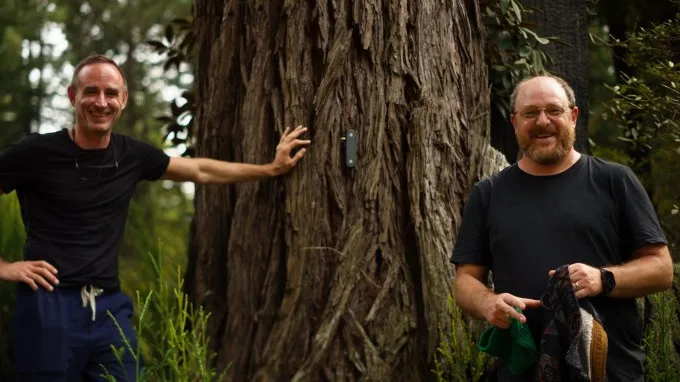
Image: Two men stand next to a large tree trunk with a sensor attached to it. · Source
Electric Plant has created Bombadil, an AI-powered model that interprets electrical signals in plants to reveal their needs, aiming to improve agricultural efficiency and sustainability.
Electric Plant, co-founded by Justin Mast and neuroscientist Lee von Kraus, is pioneering a novel approach to understanding plant communications through electrical signals. Inspired by research demonstrating that plants emit subtle electrical currents to communicate needs such as light exposure, the startup has spent the past three years developing Bombadil, a large language model trained to decipher these bioelectrical signals across more than 125 plant species.
The technology hinges on specialized sensors affixed to plants with stainless steel screws penetrating the cambium layer, detecting microvolt changes in electrical activity within the plant. These sensors, costing tens of dollars each, relay data over a low-power wireless network to the cloud, where Bombadil processes the signals and provides actionable insights to growers. According to Mast, this system can optimize watering and fertilizing schedules, potentially increasing crop yields while cutting water usage by 20% or more.
Traditional tools such as soil probes, handheld spectrometers, and satellite imagery offer indirect and often delayed indications of plant health, but Electric Plant asserts that Bombadil’s real-time interpretation of internal plant signals offers a far more immediate and precise understanding. The model's diverse training on species ranging from ferns and redwoods to tomatoes and dahlias marks it as the most comprehensive biological electrical signal interpreter to date, with no comparably advanced animal-focused models existing.
Electric Plant has recently secured $11.2 million in a seed funding round led by Onto Ventures and Climactic to advance sensor deployment and platform development. While the startup has not disclosed its initial customers, the technology's applications are promising for agriculture and forestry, where improved plant monitoring can lead to more efficient resource use and higher productivity.
Co-founder Mast envisions a future in which humans not only listen to plant signals via AI but also engage in a two-way dialogue, effectively "speaking" with plants. Currently, the focus remains on enhancing the listening capability as a first critical step toward this goal. This innovation could transform how growers understand and respond to plant needs, fostering more sustainable and responsive cultivation practices.
Sources and original reporting
Read the original source ↗
Comments (0)
No comments yet. Start the discussion.
Write a comment
Comments are published after moderation. Your name and comment will be visible publicly. Account