
New Insights into the Mechanics Behind Hawaii’s Kilauea Lava Fountains
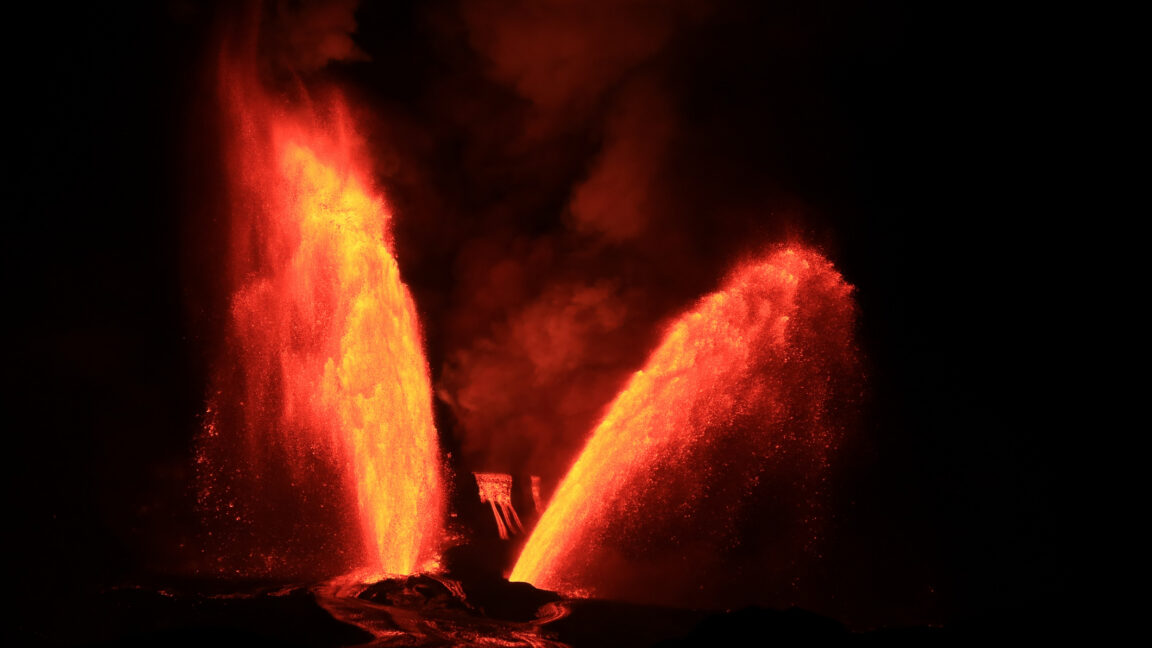
Image: Ars Technica · Source
US Geological Survey research on Kilauea’s recent eruptions offers clues to predicting lava fountains and suggests steam-driven processes over carbon dioxide foam as the fountain’s power source.
The spectacular lava fountains of Hawaii’s Kilauea volcano have long fascinated volcanologists, yet the forces driving these molten jets reaching hundreds of meters high remain partially shrouded in mystery. Recent eruptions have provided an unprecedented opportunity to study and better understand these dramatic volcanic phenomena.
Kilauea, the youngest and most active volcano in Hawaii, typically exhibits slow-moving lava flows. However, since 1823, it has experienced only three episodes of lava fountaining. Following a major 2018 eruption that partially emptied an underground magma reservoir, scientists from the US Geological Survey (USGS) monitored the site intensively using a network of 35 stations equipped with seismic, infrasound, geodetic, gas sensors, and thermal and visual cameras.
From 2019 onward, the magma reservoir beneath Kilauea began refilling slowly at first, then accelerating notably by 2023, causing the summit to inflate at a growing rate, first 22 centimeters per year and then 57 centimeters. In 2024, a series of earthquakes occurred as a 900-meter fissure opened, launching lava fountains as high as 160 meters over 13 hours. Soon after, a second eruption followed. By the following month, USGS recorded 52 additional fountain eruptions, some ejecting lava over 400 meters high.
Key findings from this activity included the ability to predict the timing of eruptions by monitoring the summit tilt of Kilauea. Each eruption caused rapid summit deflation and was followed by gradual magma reservoir refill. Consecutive eruptions happened when summit tilt measurements reached similar thresholds, enabling improved eruption alert forecasts despite a lack of clear seismic signs immediately before fountain activity.
Regarding the mechanisms driving these lava fountains, two main hypotheses exist. One attributes the fountains to steam generated when water in the magma reservoir reaches shallower depths and flashes to steam, fragmenting the magma and propelling it upward. The alternative points to carbon dioxide forming a foam atop the magma chamber that releases gas suddenly to drive fountains.
Data from the recent eruptions show low carbon dioxide levels throughout the eruption cycle, weakening support for the foam theory. Sulfur dioxide levels rose during eruptions but remained high overall, indicating continuous gas escape from magma but with increased activity during fountain events. This evidence favors the steam-driven eruption model, though it remains unclear why steady processes erupt suddenly into fountains.
Chemical analysis of magma samples revealed fluctuating magnesium oxide levels, reflecting temperature changes consistent with magma depletion and replenishment cycles. Other oxides increased over time, suggesting new magma arriving with distinct chemistry.
Despite extensive instrumentation, challenges remain, particularly in gas sampling hampered by infrared interference during lava fountains and safety risks from the towering jets. One camera was lost capturing close-up footage of molten rock falling from the heavens.
Kilauea continues to serve as a powerful natural laboratory elucidating volcanic eruption dynamics. While recent studies mark significant progress in understanding and forecasting lava fountains, much remains to be learned to fully unveil the secrets of these fiery displays.
(Scientific reference: USGS research published in Science, October 2026, DOI: 10.1126/science.aef2931)

Sources and original reporting
Read the original source ↗
Comments (0)
No comments yet. Start the discussion.
Write a comment
Comments are published after moderation. Your name and comment will be visible publicly. Account