
Researchers Achieve Quantum Entanglement Between a Glass Bead and Light
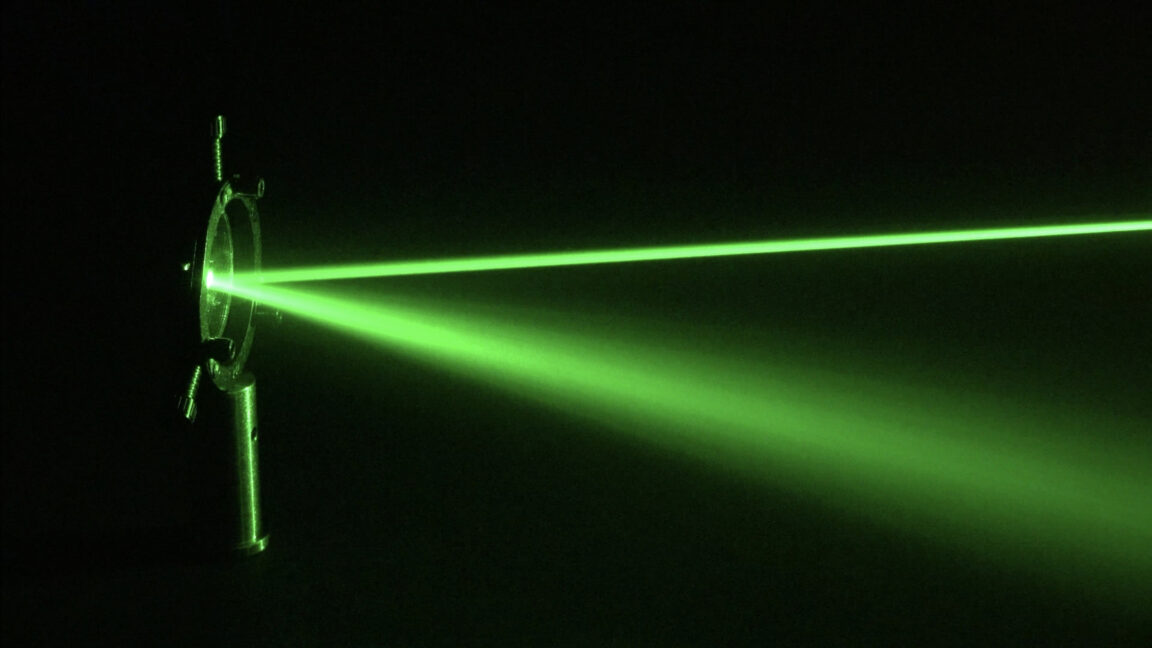
Image: Ars Technica · Source
Scientists have successfully entangled a suspended glass bead with laser light in an optical cavity, marking a significant advance in quantum mechanics and opening possibilities for quantum memory applications.
Quantum entanglement, a phenomenon where two objects exhibit correlated behaviors regardless of distance, has long been understood primarily in microscopic systems like photons. Extending entanglement to visible macroscopic objects has posed significant challenges due to environmental interactions that quickly dissipate quantum correlations. However, recent research has demonstrated entanglement between a glass bead and light, representing a notable experimental achievement.
In this experiment, researchers used laser light to trap and cool a tiny glass bead suspended in an optical cavity formed by two mirrors. The cavity sets standing wave patterns of light at fixed phase and frequency points, enabling a well-defined interaction between the bead and the light field, provided the bead's motion remains minimal. Cooling here refers to reducing the bead’s vibrational motion within the laser trap, achieved by tuning the laser to a slightly lower frequency so that the bead loses energy to the light through the Doppler effect.
To induce entanglement, a second laser beam with a slightly higher frequency was used to inject energy back into the bead's motion. The interplay between the cooling and heating laser fields creates correlations between the bead's vibrations and the light fields. Because some light escapes the cavity, carrying subtle fluctuations tied to the bead’s motion, measuring correlations in these leaking light fields reveals the entangled state.
This intricate balancing of laser frequencies and the precise control of the bead’s motion allowed the team to observe entanglement between a macroscopic object—a glass bead—and light for the first time. Such measurements are complex and noise-sensitive, requiring sophisticated models to differentiate entangled states convincingly.
Beyond its fundamental physics implications, this mechanical-light entanglement system offers promising applications. In quantum communication, photons are essential carriers of information, but storing quantum information encoded in light typically presents difficulties. A mechanical system like the glass bead can serve as a localized quantum memory, with tunable properties tailored through artificial design.
This development not only highlights the universality of quantum mechanics but also demonstrates new pathways to harness quantum phenomena in artificial systems, potentially advancing quantum technologies in communication and computing.

Sources and original reporting
Read the original source ↗
Comments (0)
No comments yet. Start the discussion.
Write a comment
Comments are published after moderation. Your name and comment will be visible publicly. Account