
NVIDIA Vera Rubin Platform Dominates MLPerf Training and Endpoints Benchmarks
Image: NVIDIA · Source
NVIDIA's new Vera Rubin platform leads MLPerf Training v6.1 benchmarks across all categories and delivers over 10x efficiency gains in MLPerf Endpoints agentic AI throughput per watt.
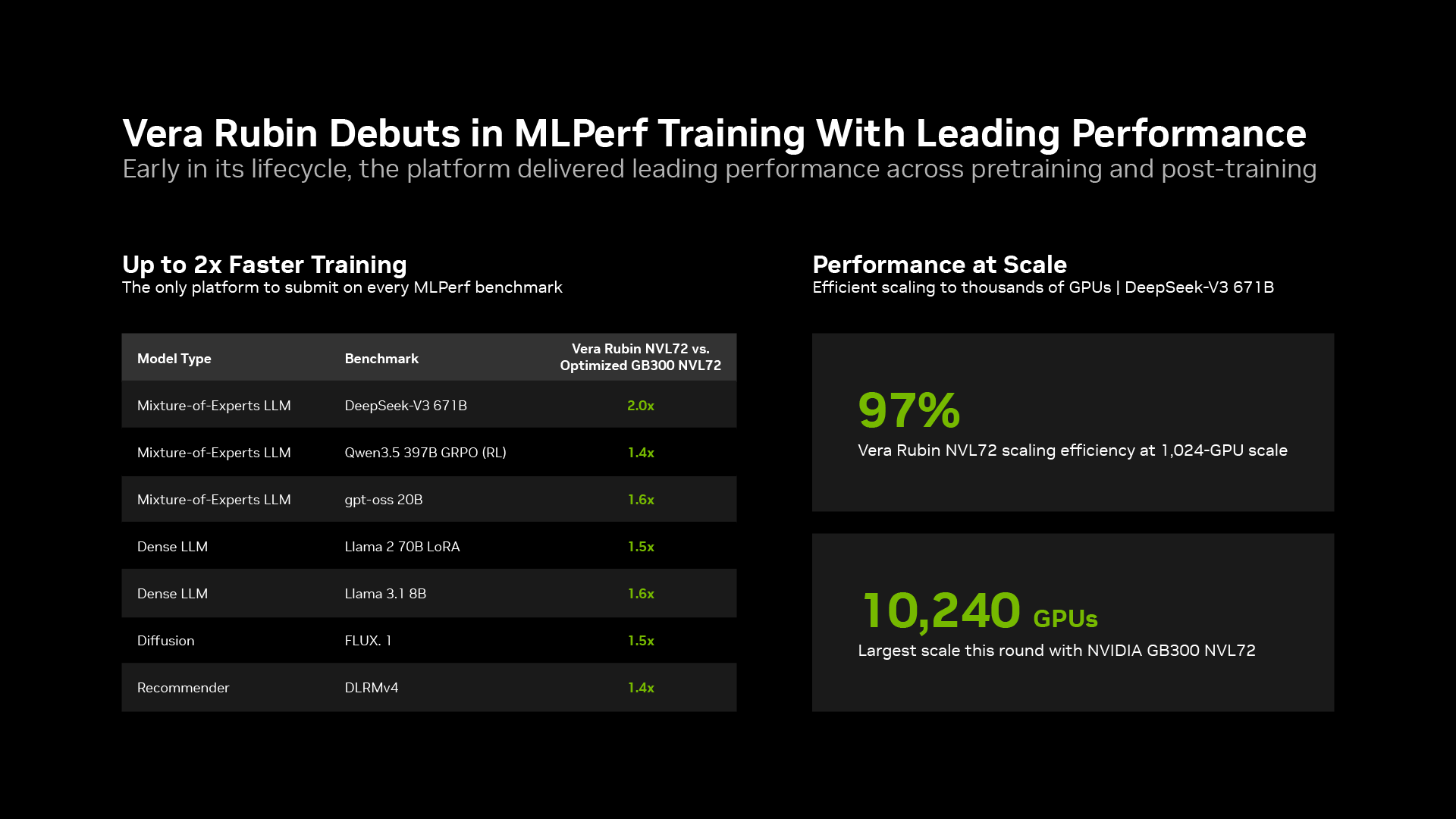
NVIDIA has achieved a sweeping victory with its Vera Rubin platform in the latest MLPerf benchmarking results, marking a strong debut across both training and inference performance metrics. In the recently released MLPerf Training v6.1 benchmarks, NVIDIA’s Vera Rubin system was the only platform to submit results for every benchmark, spanning large language models, image generation, recommendation systems, and reinforcement learning post-training. It delivered up to twice the performance per GPU compared to the highly optimized NVIDIA GB300 system, highlighting rapid generational improvements in their hardware and software.
Scalability was a highlight for Vera Rubin, particularly on the DeepSeek-V3 benchmark, where the system maintained approximately 97% scaling efficiency from 256 up to 1,024 GPUs, reducing training time from 16 minutes to about four minutes. NVIDIA also demonstrated training at massive scale: GB300 systems ran benchmarks using 10,240 GPUs, the largest scale observed this round, matched by Microsoft Azure using GB200 systems. This underscores the importance of efficient multi-GPU coordination, achieved through NVIDIA’s NVLink scale-up networking within systems, and Quantum-X800 InfiniBand and Spectrum-X Ethernet scale-out networking across data centers.
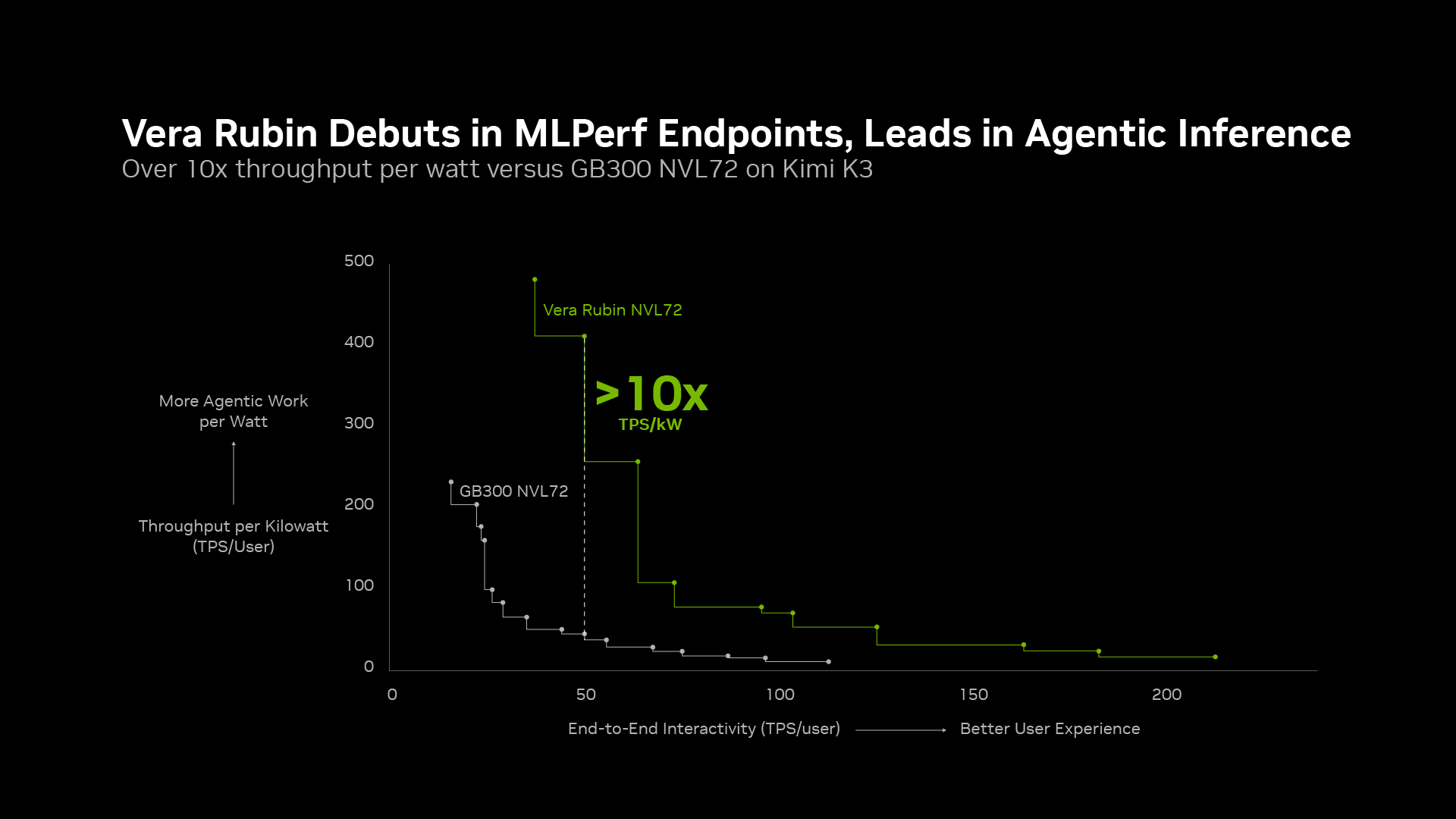
In a first for NVIDIA at MLPerf Endpoints, targeting agentic AI inference workloads, Vera Rubin platforms delivered more than a tenfold improvement in throughput per watt compared to previous-generation systems such as the GB300, while maintaining response latencies. This is critical because agentic AI tasks often require multi-step reasoning and repeated tool invocations, generating many tokens for each completed action. Higher token generation per watt means data centers can serve more AI agents simultaneously at lower power costs.
NVIDIA's partner ecosystem played a key role in these achievements, with submissions from 20 organizations including Asus, Cisco, Dell Technologies, Google Cloud, HPE, Oracle, Supermicro, and others. These contributions reflect the versatility and optimization potential of NVIDIA’s CUDA-powered software stack combined with its latest hardware architecture.
Beyond MLPerf, Vera Rubin also leads in independent AI agent benchmarks such as SemiAnalysis AgentX and Artificial Analysis AgentPerf, confirming its capability across pretraining, post-training, and agentic inference workloads. It also supports high-performance computing demands, as showcased at the recent SC26 conference. NVIDIA indicates that ongoing software optimizations will further enhance Vera Rubin’s performance, promising continual value expansion for customers investing in this infrastructure.
For detailed technical insights, NVIDIA’s MLPerf Training and MLPerf Endpoints blogs offer comprehensive analysis of the benchmark achievements and underlying system configurations. The Vera Rubin platform firmly establishes NVIDIA’s leadership in accelerating AI training and inference at scale, combining power efficiency with unmatched throughput and scalability.
Sources and original reporting
Read the original source ↗
Comments (0)
No comments yet. Start the discussion.
Write a comment
Comments are published after moderation. Your name and comment will be visible publicly. Account