
IBM, Fermilab, and NVIDIA Collaborate on Modular Quantum Computing Co-Design Platform to Advance Next-Gen Quantum-Classical Integration
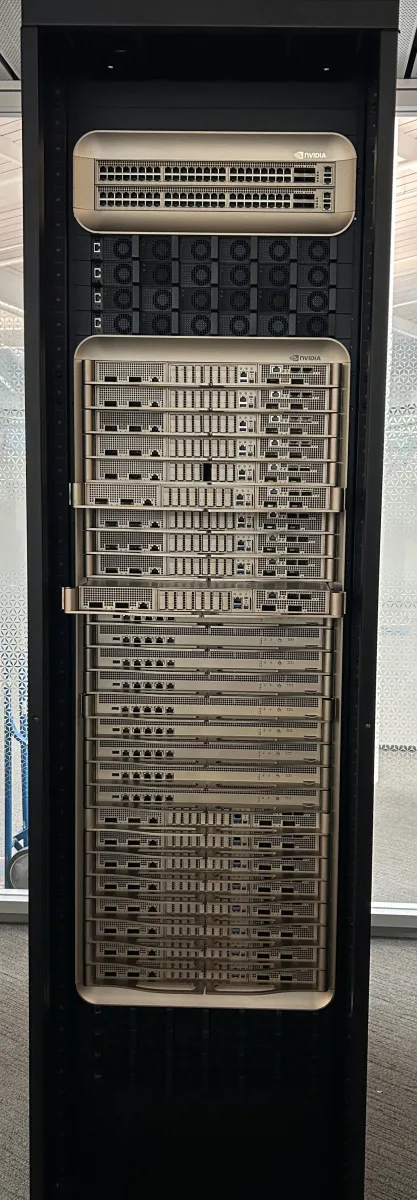
Image: Illustrative image · Pokiiri · CC BY-SA 4.0 · Source
IBM, Fermilab, and NVIDIA announced a joint initiative to develop a modular quantum computing co-design platform combining IBM Quantum Nighthawk processors and NVIDIA DGX systems, aiming to scale quantum-classical computing for science challenges in high-energy and nuclear physics.
On November 16, 2026, IBM unveiled plans to collaborate with NVIDIA and Fermi National Accelerator Laboratory (Fermilab) to accelerate the development of next-generation, modular quantum computers. This initiative focuses on advancing the integration of quantum processors with classical high-performance computing (HPC) resources to tackle computationally intensive scientific problems that are beyond the capabilities of classical systems alone.
The collaboration involves launching a modular quantum computing co-design platform that co-locates IBM Quantum Nighthawk systems—the most powerful quantum processors from IBM, featuring 120 qubits and capable of executing up to 100,000 circuits per second—with NVIDIA DGX B200 accelerated computing platforms. Fermilab’s Superconducting Quantum Materials and Systems (SQMS) Center contributes expertise in superconducting quantum materials, ultracoherent quantum hardware, and prospective quantum interconnects crucial for scaling modular quantum architectures.
This platform is intended to enable researchers to explore innovations required for linking multiple quantum processors and scaling classical computation alongside them. The combined system aims to facilitate investigations in high-energy and nuclear physics, such as lattice gauge theories, neutrino interactions, and nuclear simulations, domains that pose extreme computational challenges.
A key technological advancement in this collaboration is the deep integration of quantum processors into HPC workflows. IBM and NVIDIA have worked to incorporate the Quantum Resource Management Interface (QRMI) with Slurm’s Hierarchical Resources scheduling system, allowing quantum processing units (QPUs) to be allocated and managed alongside CPUs and GPUs in existing supercomputing environments. This vendor-agnostic middleware enables shared QPU resource management without disrupting established HPC job scheduling, easing the development of quantum-classical hybrid workflows.
IBM’s Quantum Nighthawk r2 processor, accessible through the IBM Quantum Platform, exemplifies the progress in hardware capable of supporting these efforts. It features independent, high-speed qubit reset mechanisms that drastically reduce idle time between quantum circuits, boosting execution throughput by 25 times compared to its predecessor, IBM Quantum Heron. Nighthawk r2 supports circuits with more than 7,500 gates, a significant step toward practical quantum error correction and fault-tolerant quantum computing.
Complementing the hardware advances, researchers at IBM, RIKEN, and NVIDIA demonstrated the potential of these integrated systems by applying sample-based quantum diagonalization (SQD) to study complex iron-sulfur clusters found in biological molecules. Their hybrid quantum-classical workflow delivered accuracy improvements by 79-fold compared to previous results and closely approached the precision of advanced classical simulation methods.
The initiative reflects a broader strategy to embed quantum computing firmly within classical HPC infrastructures, facilitating the eventual deployment of fault-tolerant quantum computing capabilities integral to future scientific discovery. Fermilab’s Anna Grassellino emphasized the goal of co-designing applications, algorithms, and modular quantum architectures to create quantum computers built for meaningful scientific exploration. This work aligns with the Department of Energy’s Quantum Genesis initiative, aiming for operational fault-tolerant quantum systems by 2028.
For researchers and HPC centers, the developments promise not only enhanced hardware but also software tools and workflow integrations to harness quantum and classical resources seamlessly, accelerating inquiry into previously intractable scientific problems. Access to IBM’s advanced quantum processors and integrated platforms is available now through the IBM Quantum Platform, with ongoing collaborations poised to expand the quantum computing ecosystem alongside leading HPC technologies.

Sources and original reporting
Read the original source ↗
Comments (0)
No comments yet. Start the discussion.
Write a comment
Comments are published after moderation. Your name and comment will be visible publicly. Account