
IBM Unveils Quantum Nighthawk r3 Processor, Plans 1,000+ Qubit System by 2027
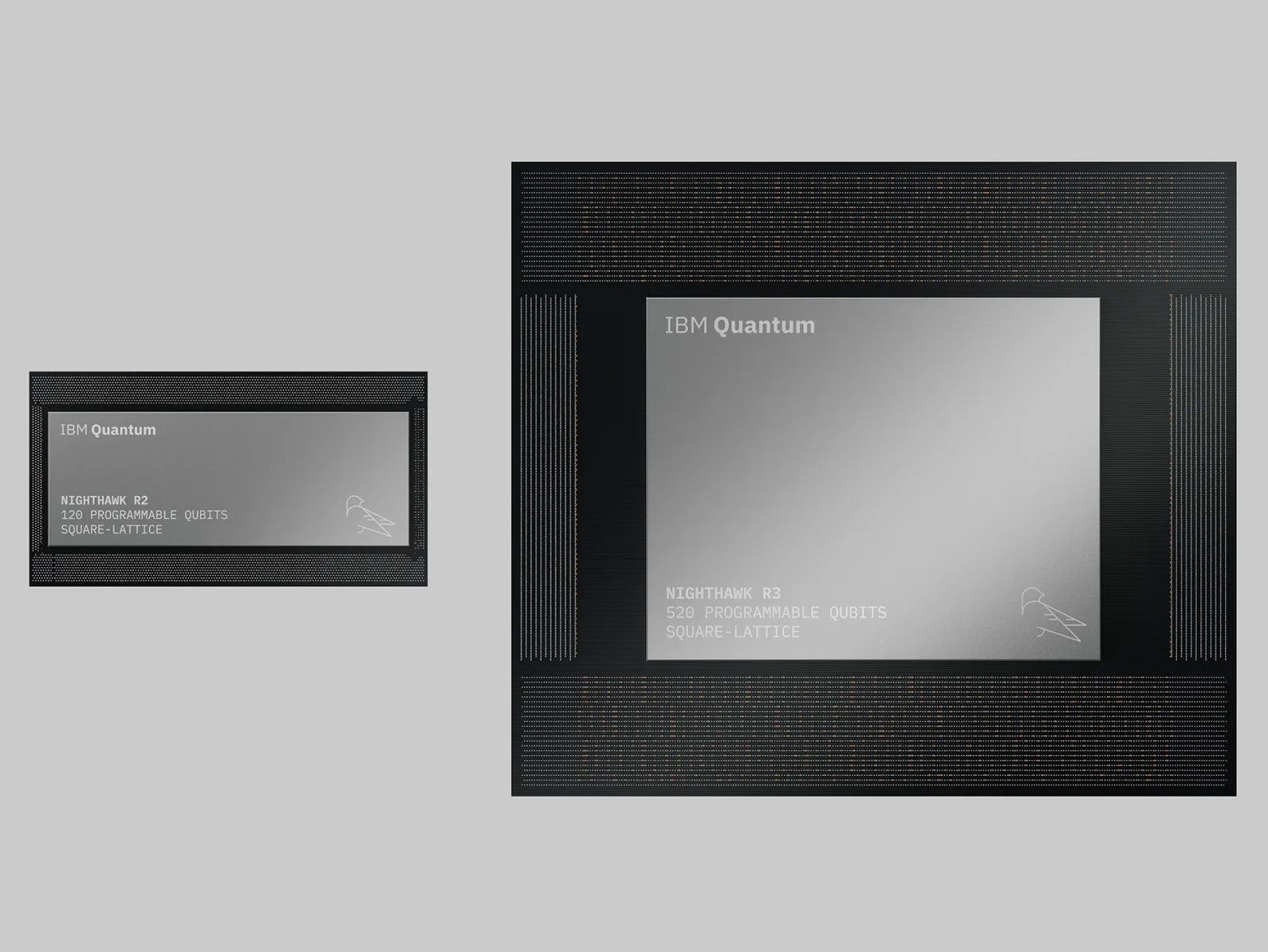
Image: IBM · Source
IBM introduces its Quantum Nighthawk r3 processor, targeting 10,000 quantum operations on 520 qubits, and reveals plans to link two such processors into a 1,040-qubit system in 2027, advancing speed and scale toward fault-tolerant quantum computing.
IBM has announced the next advancement in its quantum computing roadmap with the introduction of the IBM Quantum Nighthawk r3 processor. This state-of-the-art processor is designed to perform 10,000 quantum operations across 520 programmable qubits, marking a significant leap in both the scale and computational quality of quantum hardware. IBM's plans include linking two Nighthawk r3 processors in 2027 to create a modular system exceeding 1,000 qubits, aiming to tackle increasingly complex and larger-scale quantum computations.
This announcement builds upon the capabilities delivered by the current generation IBM Quantum Nighthawk r2 processor, which was introduced earlier in 2026 and supports 120 programmable qubits. Nighthawk r2 features a high-speed qubit reset technology that enables execution speeds of over 100,000 circuits per second, a 25-fold improvement over its predecessor IBM Quantum Heron. This technology dramatically enhances throughput by reducing idle time between quantum circuit executions from hundreds of microseconds down to as little as one microsecond without compromising computational accuracy.
The modular design of Nighthawk r3 introduces ten chip-to-chip interconnects known as l-couplers, facilitating the connection of multiple processors into larger quantum systems. IBM has demonstrated the ability to maintain high quantum state transfer fidelity—up to 99.3%—between connected processors using l-couplers earlier in 2026. These developments underpin IBM's scalability ambitions for quantum computers that effectively combine multiple processors to exponentially increase qubit counts.
A critical part of IBM’s quantum progress involves the integration of quantum and classical computing resources to address error correction and complex workload orchestration. The IBM Quantum Platform now unifies high-performance classical computing and quantum processing in a managed environment, enabling hybrid quantum-classical workflows with extensive capacity for parallelism and high memory usage. This integrated approach supports advanced studies such as quantum error correction and large-scale simulations by accelerating data processing and sample collection.
IBM emphasizes that speed and fidelity are both crucial: faster qubit resets reduce initialization errors by around 25 times while preserving high gate fidelity. This balance enables the execution of longer and more complex circuits containing over 7,500 quantum operations, an important milestone achieved by Nighthawk r2.
Industry partners such as energy firm E.ON, research institutes including Oak Ridge National Laboratory, and startups like Algorithmiq have already reported significant performance improvements and practical results from their work on Nighthawk systems. For instance, E.ON achieved up to a 15-fold speedup in quantum machine learning for energy grid optimization, and quantum simulations have been accelerated by up to 12 times compared with earlier IBM quantum processors.
Looking ahead, IBM’s roadmap targets the 2029 introduction of IBM Quantum Starling, a fault-tolerant quantum computer designed to perform hundreds of millions of quantum operations. Starling will build upon modular architectures and l-coupler interconnects demonstrated in Nighthawk processors, alongside innovations in quantum memory, decoders, cryogenics, and control electronics.
IBM's latest progress underscores an industry shift from benchmarking quantum advantage toward delivering useful computational applications across sectors like energy, chemistry, and finance. The company continues to expand supporting software tools, integration models, and developer workflows to enable the broad research community and enterprise clients to exploit quantum computing advances via IBM Quantum Platform.
Overall, IBM’s unveiling of the Nighthawk r3 processor and forthcoming 1,040-qubit system highlights its commitment to scaling quantum computing to practical, high-fidelity levels within the next few years, advancing the transition from experimental advantage demonstrations to impactful, real-world quantum applications.


Sources and original reporting
Read the original source ↗
Comments (0)
No comments yet. Start the discussion.
Write a comment
Comments are published after moderation. Your name and comment will be visible publicly. Account