
NVIDIA and Korean Industry Drive Physical AI from Semiconductor Design to Autonomous Vehicles
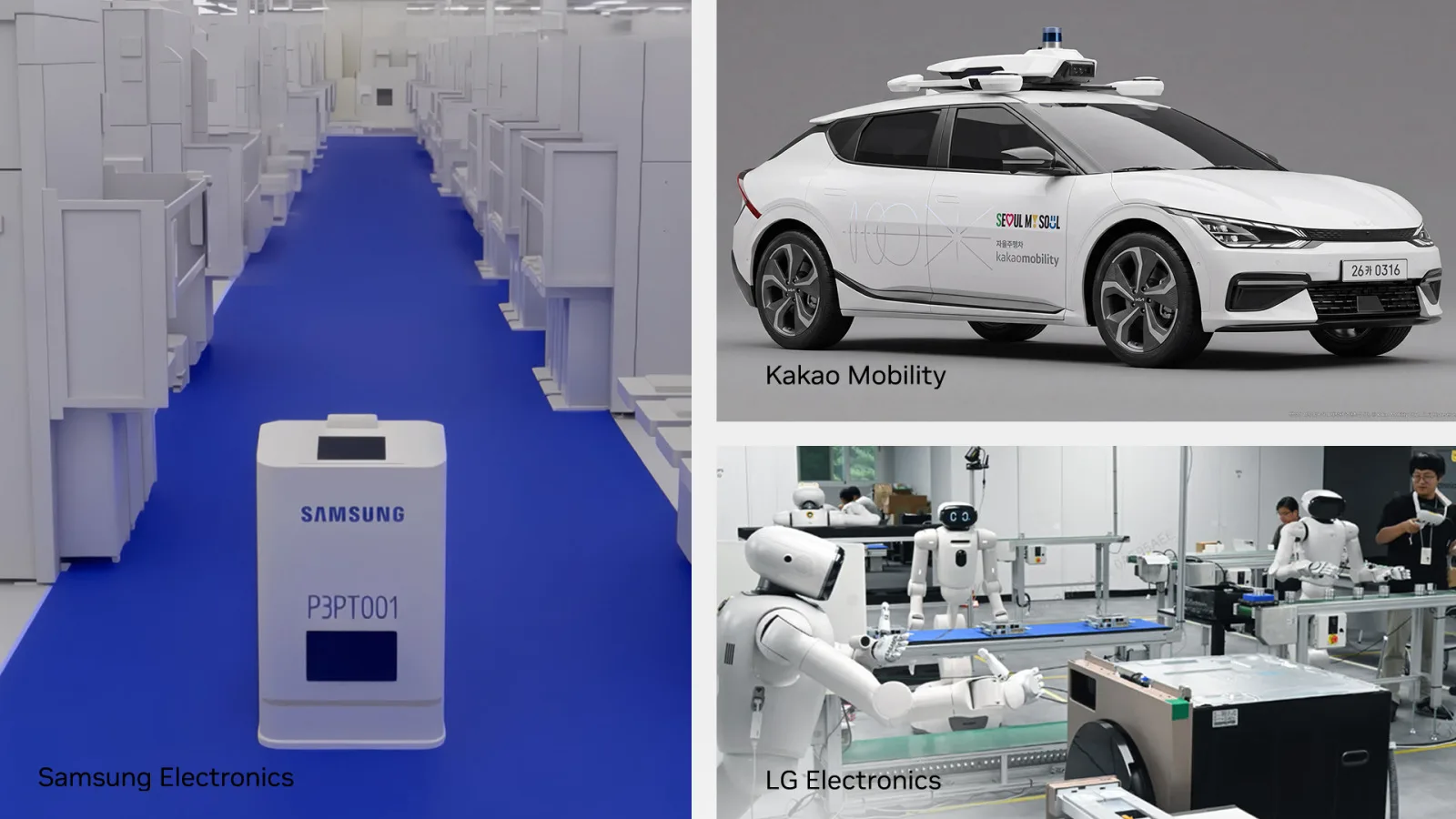
Image: NVIDIA · Source
NVIDIA collaborates with Korean tech leaders Samsung, Kakao Mobility and LG Electronics to advance physical AI in semiconductor engineering, autonomous driving and robotics, leveraging AI physics, accelerated computing and simulations.
Korea is making significant strides in physical artificial intelligence (AI) across multiple industries through partnerships with NVIDIA, leveraging the country’s advanced manufacturing and engineering capabilities. The collaboration brings accelerated computing, AI-driven physics, and simulations into practical applications ranging from semiconductor manufacturing to robotics and autonomous mobility.
Samsung Electronics is enhancing its semiconductor engineering using NVIDIA’s accelerated computing and AI physics technologies. The collaboration encompasses materials research, process development, and device engineering. Samsung utilizes NVIDIA’s cuISS and cuDSS libraries to speed up calculations involving sparse linear systems critical for semiconductor design, as well as GPU acceleration for process and optical simulations. Its sMOL platform has achieved up to fivefold faster quantum chemical computations using NVIDIA’s cuEST library, while NVIDIA’s cuEquivariance aids in training atomistic AI models.
Thermal and mechanical analysis at the chip scale has been accelerated using NVIDIA PhysicsNeMo, enabling a dramatic approximately 1,600x speedup in simulation times by combining AI-predicted material properties with GPU acceleration and coarser simulation grids. Future plans include employing NVIDIA’s Agent Toolkit to integrate these simulation tools and AI models, aiming to empower engineering agents to autonomously run complex analyses and compare design options.
In autonomous driving, Kakao Mobility is building on NVIDIA’s vehicle computing and safety technologies to develop a level 4 autonomous system. Utilizing NVIDIA Hyperion and DRIVE AGX Thor platforms, alongside proprietary driving software, the company intends to integrate its autonomous capabilities on Kia’s purpose-built vehicles, focusing initial development around Seoul’s Gangnam district. NVIDIA Halos will support safety functions throughout the development and validation phases.
LG Electronics collaborates with NVIDIA to advance robotic learning and factory simulation through its CLOiD robot. Using the NVIDIA Isaac GR00T platform, the teams have demonstrated robotic manipulation and manufacturing tasks in actual environments. They have created a physical AI data flywheel involving real-world data collection, data augmentation with NVIDIA Cosmos, model training with GR00T, on-board computing via Jetson AGX Thor, and simulation-based evaluation to enable continuous robot capability improvement.
Beyond Korea, NVIDIA is expanding its Agent Toolkit globally by integrating NVIDIA PhysicsNeMo and CUDA-X libraries. These enhancements enable autonomous AI engineering agents equipped with AI physics expertise, accelerated solvers, and quantum chemistry capabilities to transform chip and system design workflows. Industry leaders such as Cadence, Siemens, Synopsys and others employ these tools to expedite design, verification, packaging, and system integration.
This broad collaboration exemplifies how AI physics and accelerated computing are being harnessed to transition physical AI from experimental development into real-world, large-scale industrial production across Korea’s key technological sectors.
Sources and original reporting
Read the original source ↗
Comments (0)
No comments yet. Start the discussion.
Write a comment
Comments are published after moderation. Your name and comment will be visible publicly. Account