
Google Unveils Four Specialized TPUs in 2026 Including Secure and High-Context Models
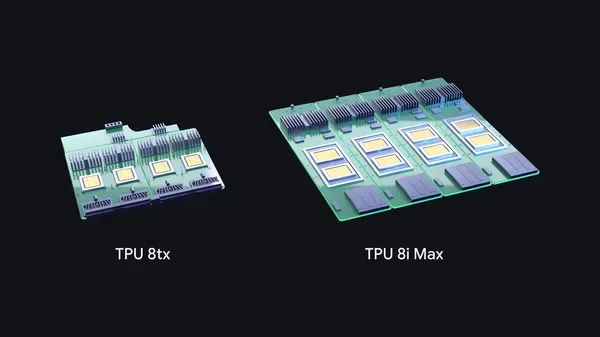
Image: Google · Source
Google expands its eighth-generation TPU lineup with TPU 8tx and TPU 8i Max, complementing TPU 8t and 8i, to address secure inference and massive context workloads for AI agents.
In November 2026, Google announced a significant expansion of its eighth-generation Tensor Processing Unit (TPU) portfolio by introducing two new systems, TPU 8tx and TPU 8i Max, alongside the previously launched TPU 8t and TPU 8i. This marks the first time Google has released four TPU variants within a single year, reflecting the escalating complexity of AI workloads and the need for specialized hardware.
Originally developed over a decade ago to support Google's internal AI demands like voice recognition and language translation, TPUs have evolved to serve diverse applications including training and deploying Gemini AI models, agentic workloads, and providing cloud services to a growing customer base approaching 100 organizations worldwide.
The TPU 8t is engineered for large-scale training of foundational AI models, focusing on maximizing training performance measured as useful intelligence output per watt. The TPU 8i variant targets real-time reasoning tasks by efficiently addressing memory bottlenecks and reducing inter-chip communication delays.
The newly announced TPU 8tx targets secure and confidential AI inference workloads, fulfilling needs from regulated sectors such as enterprises and government agencies. Using the same silicon as TPU 8t combined with AMD EPYC CPUs, TPU 8tx incorporates hardware-level encryption to protect sensitive data and model parameters in active use while maintaining low latency through a specialized Boardfly network. This system supports private fine-tuning, distillation, and reinforcement learning on a single platform without data migration, meeting stringent security requirements.
TPU 8i Max addresses the challenge of massive context windows necessary for agentic AI that reasons across extensive data such as codebases or video. By packaging two TPU 8i chips together, it doubles compute power, SRAM, and high-bandwidth memory, enabling large workloads to run without stalls and increasing compute density per rack footprint.
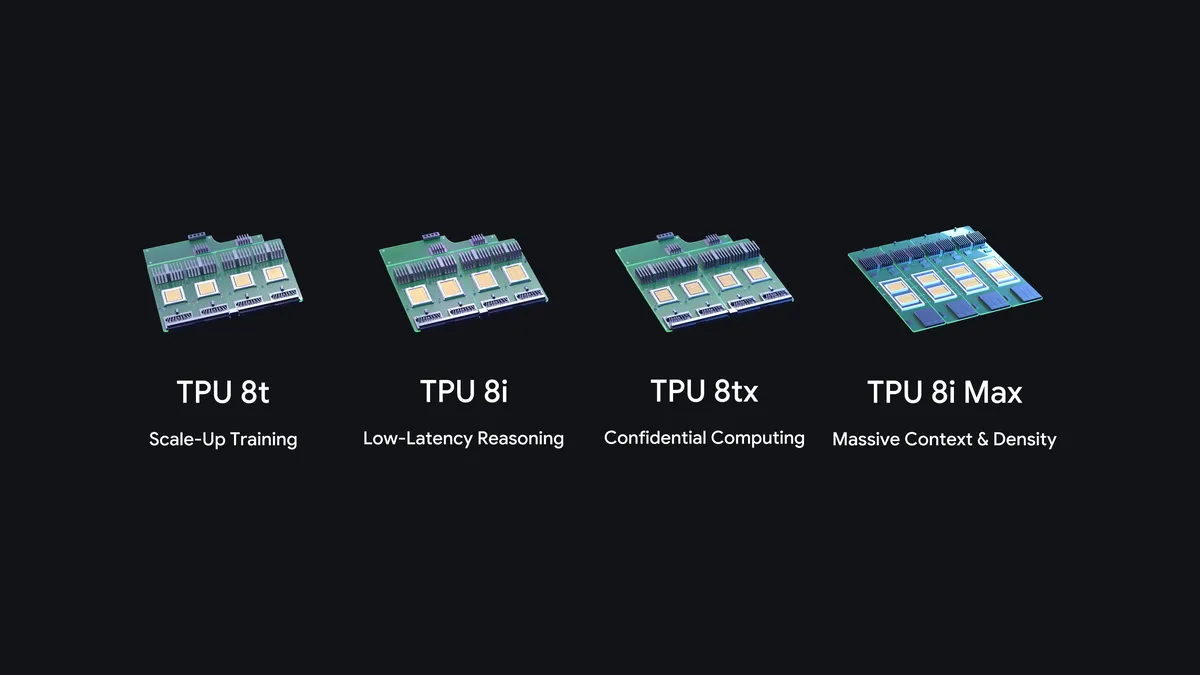
These four systems collectively provide purpose-built accelerators optimized for various AI lifecycle stages: TPU 8t for scale-up training, TPU 8i for low-latency reasoning, TPU 8tx for confidential computing, and TPU 8i Max for large-context and high-density computing.
Complementing the hardware, Google has enhanced TPU accessibility by supporting popular frameworks like PyTorch via open-source TorchTPU, enabling seamless deployment and optimization without code rewrites. Additional tools like the TPU agent suite and TPU Sync software layer facilitate automated onboarding, memory management, and scaling of large TPU clusters.
Google emphasizes a co-design approach with Google DeepMind and AI-powered development techniques to rapidly innovate TPU hardware and systems. This integrated design process accelerates development cycles and prepares the infrastructure for the growing demands posed by agentic AI and large language models.
For further information, Google offers a detailed broadcast and online resources outlining the specifications and capabilities of these TPU systems, aimed at empowering developers and enterprises to harness next-generation AI infrastructure efficiently and securely.
Sources and original reporting
Read the original source ↗
Comments (0)
No comments yet. Start the discussion.
Write a comment
Comments are published after moderation. Your name and comment will be visible publicly. Account