
Google Launches Two New Specialized TPUs to Enhance AI Workloads
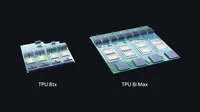
Image: TPU 8tx and TPU 8i Max · Source
Google expands its eighth-generation Tensor Processing Unit (TPU) lineup with TPU 8tx for confidential AI model training and TPU 8i Max for increased memory capacity, addressing security and context window demands in AI applications.
Google has announced two new additions to its eighth-generation Tensor Processing Unit (TPU) portfolio, enhancing its capabilities across various AI workload needs. The TPU 8tx and TPU 8i Max introduce specialized hardware features that focus on secure model training and larger memory capacity, respectively.
The TPU 8tx, developed in collaboration with AMD, builds on the TPU 8t chip and is tailored for confidential inference and training. This chip incorporates hardware-level security that protects sensitive data and model weights even while in active use, a critical feature for regulated enterprises and government entities handling proprietary or classified information. The chip’s design supports simultaneous inferencing and training, enabling organizations to fine-tune models on private data without transferring that data across devices, thereby enhancing data privacy and operational efficiency.
In contrast, the TPU 8i Max addresses challenges posed by AI workloads requiring massive context windows. By combining two TPU 8i inference-focused chips into a single package, the TPU 8i Max doubles memory capacity, processing power, and bandwidth. This design allows AI models to handle more extensive datasets and complex queries effectively while providing the highest compute density per rack, enabling data centers to increase computational power without additional physical space.
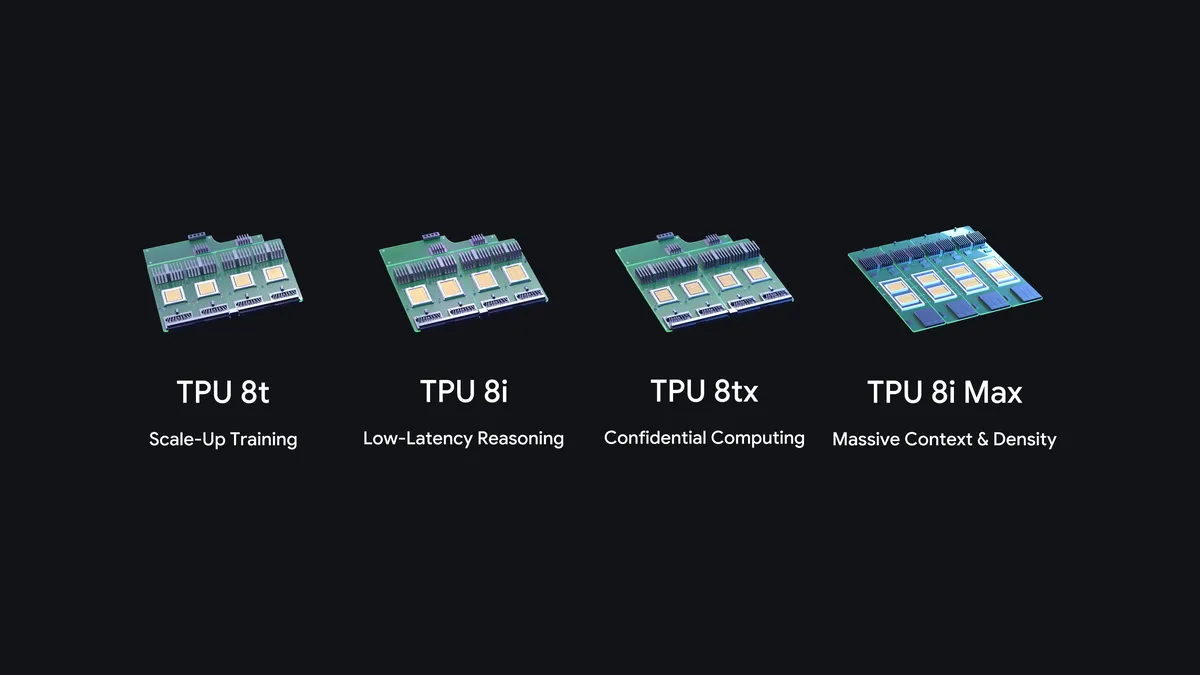
Google's TPU portfolio now comprises four systems for varied stages of AI development: TPU 8t for large-scale training, TPU 8i for low-latency reasoning, TPU 8tx for secure computing, and TPU 8i Max for extensive context management. This expanded lineup reflects Google’s approach to building modular, high-performance AI hardware integrated with flexible system design, including high-speed networking, memory, and security components.
To facilitate broader developer adoption, Google has improved TPU accessibility. Recent developments include native support for popular frameworks like PyTorch and Hugging Face, the open-sourcing of software tools for easier hardware integration, and performance optimizations that deliver state-of-the-art results on benchmarks simulating real-world AI workloads.
These advancements occur amidst a rising trend where major technology companies and AI research labs develop specialized AI chips to reduce dependency on traditional GPU vendors. Google emphasizes that these new TPU systems not only empower research and commercial AI projects but also contribute to an agile hardware-software ecosystem designed for evolving AI demands.
For more details on these TPU systems, Google has provided technical resources and a broadcast explaining their architecture and capabilities on the Google Cloud platform.
Sources and original reporting
Read the original source ↗
Comments (0)
No comments yet. Start the discussion.
Write a comment
Comments are published after moderation. Your name and comment will be visible publicly. Account