
Lambda Enhances AI Training Efficiency and Reliability with NVIDIA Photonics Co-Packaged Optics
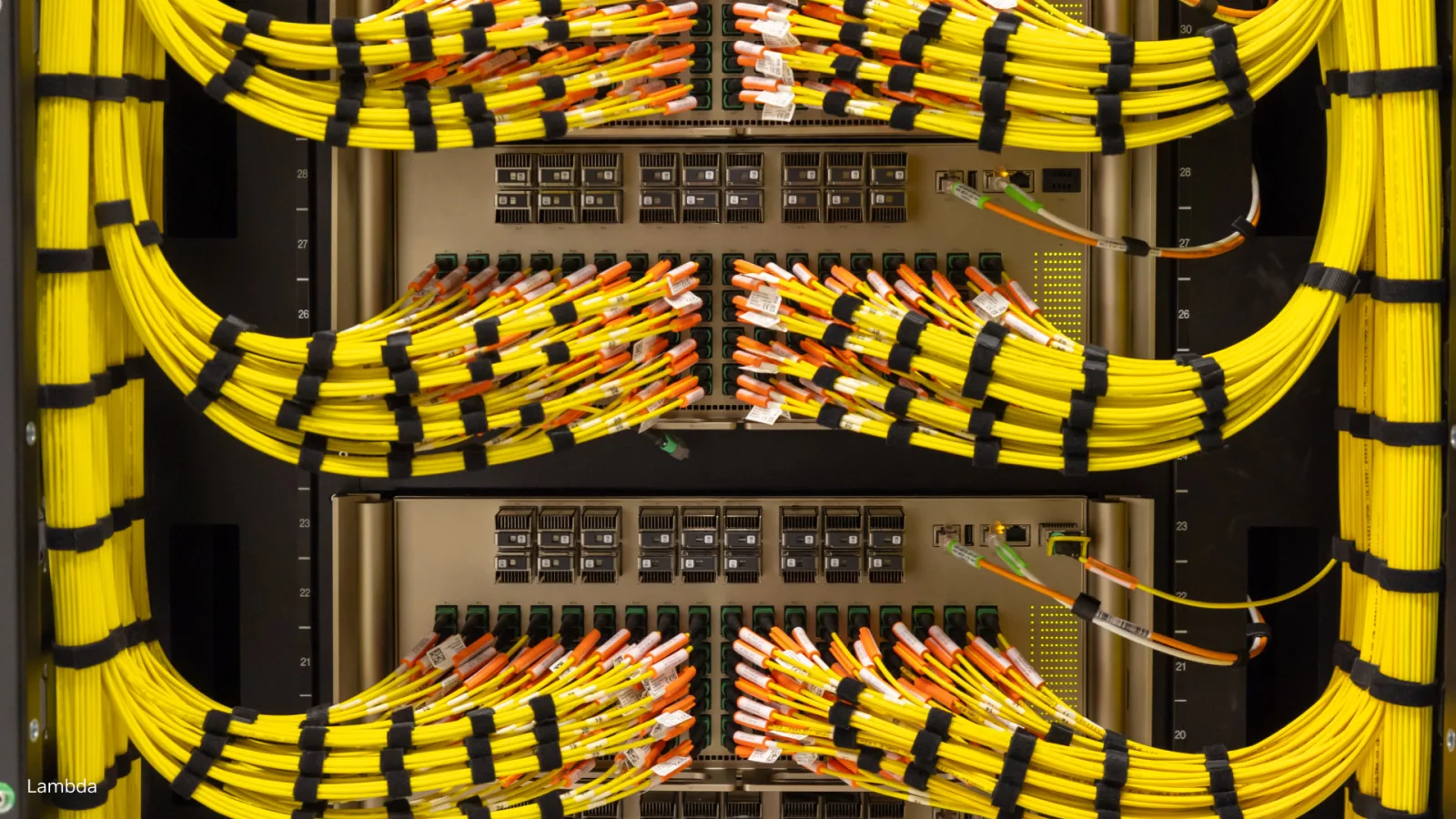
Image: NVIDIA · Source
Lambda deploys NVIDIA Photonics co-packaged optics switches to improve power efficiency, lower latency, and boost resilience in AI clusters connecting over 10,000 GPUs for large-scale model training.
Training advanced AI models demands the collaboration of thousands of GPUs, necessitating a networking infrastructure that can deliver exceptional speed, efficiency, and reliability. Lambda, a cloud services provider specializing in AI infrastructure, has addressed this networking challenge by integrating NVIDIA Photonics co-packaged optics (CPO) switches into its AI systems.
Lambda’s implementation connects NVIDIA GB300 NVL72 racks, comprising more than 10,000 GPUs, with these innovative CPO switches, enhancing the overall AI factory's resilience and efficiency. According to Dave Ward, Lambda’s president of cloud services, co-packaged optics are crucial to supporting the rapidly growing demands of large AI clusters, marking an important advancement in AI infrastructure.
Testing showed that incorporating NVIDIA Photonics switches reduced network latency by approximately 4% at rack scale and up to 10% at pod scale, all while maintaining throughput on par with traditional pluggable optics.
Power efficiency improvements are significant because networking consumes energy that could otherwise power compute operations. NVIDIA Photonics replaces conventional pluggable transceivers with optical engines integrated closely with the switch chip, resulting in up to five times better power efficiency and fifteen times higher reliability. The design also uses four times fewer lasers, minimizing potential failure points.
Thermal management benefits are noteworthy. Lambda’s setup employs liquid cooling to dissipate heat effectively, registering median optics temperatures of 36°C compared to 51°C in typical pluggable optics, contributing to improved signal integrity.
Moreover, the system's architecture includes eighteen removable external light sources per switch package, enabling field replacement of light modules—a departure from traditional optics that require full module swaps upon laser failure. By drastically shortening the electrical paths from inches to millimeters, the co-packaged optics reduce signal loss and eliminate the need for intermediate retimer chips, further cutting power consumption and component complexity.
Lambda’s adoption of NVIDIA Photonics exemplifies a strategic infrastructure enhancement that boosts AI training performance, network resilience, and energy efficiency at scale. The deployment reflects growing industry efforts to refine AI factory networks to support ever-larger and more complex AI workloads.
Sources and original reporting
Read the original source ↗
Comments (0)
No comments yet. Start the discussion.
Write a comment
Comments are published after moderation. Your name and comment will be visible publicly. Account