
Eka Robotics Raises Valuation to $1.45B with Advanced Physical AI Model for Robotic Manipulation
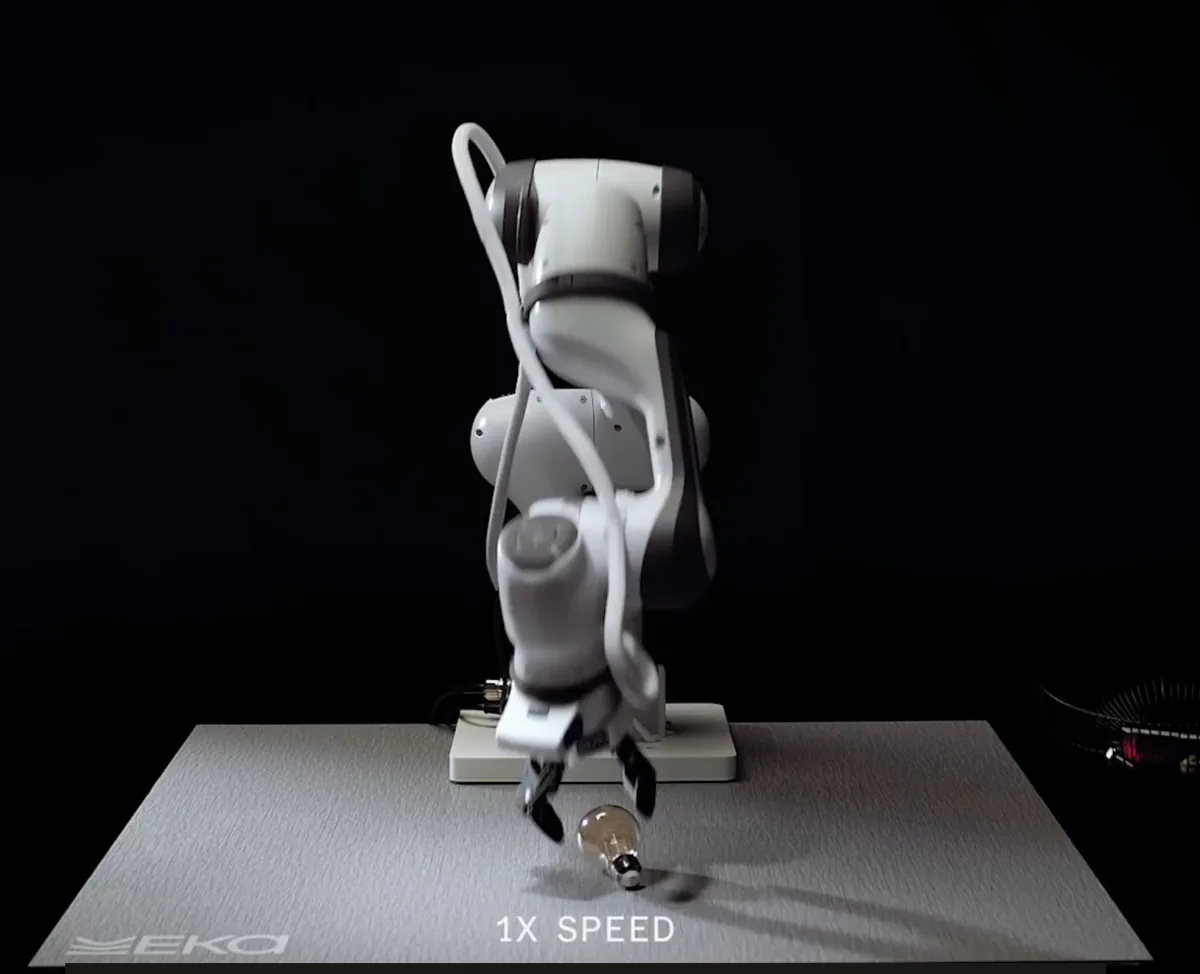
Image: TechCrunch · Source
Eka Robotics has developed a robotic arm using a novel vision-force-action AI model, achieving superhuman object manipulation and raising $150M with a $1.45B valuation. Its force-sensitive gripper enables smooth, human-like object handling, impressing robotics experts.
Despite decades of innovation and billions invested, robots have struggled with adeptly grasping and manipulating a wide variety of objects. Eka Robotics, a startup founded by MIT professor Pulkit Agrawal and former Google DeepMind researcher Tuomas Haarnoja, aims to change that with a pioneering approach that integrates physical forces into robotic AI.
On October 20, 2026, Eka announced a $150 million Series A funding round led by a16z and F-Prime, valuing the company at $1.45 billion. The company demonstrated a robotic arm equipped with a force-sensitive gripper and a novel deep learning architecture that utilizes a vision-force-action model rather than the typical vision-language-action model. This approach allows the robot to perceive and react to physical forces, enabling delicate yet rapid manipulation.
Roboticists have praised Eka’s technology as a breakthrough. Kris Hauser from the University of Illinois Urbana-Champaign described the robot’s capabilities as having a “wow factor,” highlighting its ability to adapt to numerous objects without retraining. An anonymous expert from a leading robotics lab compared witnessing Eka’s robot in action to the emotional milestone when robots first achieved reliable legged locomotion a decade prior.
Eka’s robot can pick up around 1,500 different objects weighing up to 1 kilogram each per hour, surpassing the average human rate of 600 objects in the same timeframe and boasting over 95% reliability. The smooth and rapid motion is driven by a reinforcement learning system trained extensively in physics simulations, allowing the model to experience virtual interaction scenarios at scale.
The robot’s gripper design incorporates enhanced flexibility and multiple force sensors, letting it gently grasp fragile items like a raspberry without damage. This tactile sensitivity addresses the long-standing challenge in robotics of bridging the so-called “last millimeter” — the precise, delicate physical manipulation needed at the moment of contact.
Unlike approaches reliant on human demonstrations or large video datasets, Eka’s use of simulation-driven reinforcement learning enables the robot to surpass demonstrated performances and handle many tasks autonomously. The company’s founders emphasize that this bottom-up physical interaction focus complements higher-level AI planning systems, which decide what tasks to perform but depend on accurate manipulation to execute them effectively.
Currently, Eka is conducting confidential pilot programs with industrial partners for pick-and-place and wire handling tasks. While promising, industry experts caution that the technology must prove reliable and durable on actual factory floors over extended periods to achieve commercial success. The company notes its hardware is cost-efficient (under $1,000 per gripper) and rated for 5 million cycles, aiming to reach 20 million to meet industrial standards.
Eka Robotics’ physical AI represents a significant step towards general-purpose robots capable of complex, delicate manipulation. By marrying force-aware sensing with advanced reinforcement learning, it may redefine robotic dexterity for manufacturing and logistics applications in the near future.
Sources and original reporting
Read the original source ↗
Comments (0)
No comments yet. Start the discussion.
Write a comment
Comments are published after moderation. Your name and comment will be visible publicly. Account