
A New Autonomous Vehicle Boom Fueled by AI Emerges in 2026
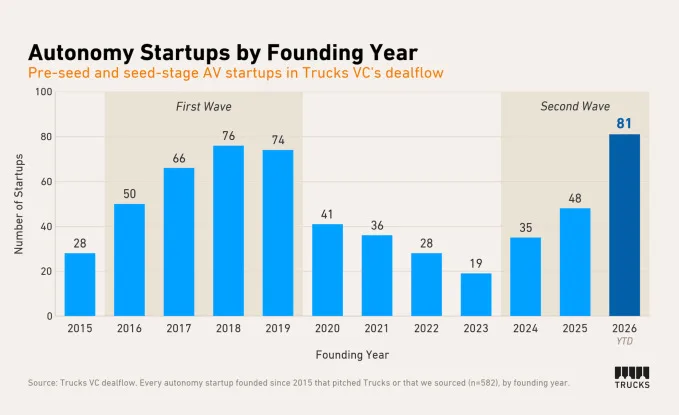
Image: Image Credits:Trucks VC · Source
The autonomous vehicle industry is experiencing a significant resurgence in 2026, driven by advances in AI foundational models enabling faster startup growth and more diverse applications including robotaxis.
The autonomous vehicle (AV) sector is undergoing what some investors are calling a second, even larger wave of innovation and startup activity in 2026, surpassing the heyday of 2016 and 2017. This renewed boom is largely attributed to breakthroughs in artificial intelligence (AI) foundational models that provide the technical basis for effective end-to-end AV systems, according to Puneeth Meruva, partner at Trucks VC, a venture capital firm focused on early-stage transportation startups.
Trucks VC reports having been pitched by 81 new AV startups so far this year, marking a two-thirds increase from 2025 and eclipsing the volume seen during the initial AV enthusiasm a decade ago. The firm notes that these foundational AI models, including open-source offerings from Nvidia and other companies, excel at generalizing across varied environments and scenarios. This capability lowers development barriers, allowing startups to deploy AV technologies within months and with funding rounds often under $1 million.
Interestingly, while many of the new startups work on typical industrial applications such as construction, warehousing, agriculture, and mining, there is a surprising surge in companies focusing exclusively on robotaxi services, positioning themselves as smaller-scale competitors to industry leaders like Waymo. Meruva suggests there is potential for niche players to operate successfully by specializing in certain regions or route types, rather than competing globally.
The influence of AI innovations is also reflected in recent funding and business developments within the broader mobility and autonomous driving ecosystem. For example, Bedrock Robotics secured $600 million in a Series C round valuing it at $4.1 billion, while companies like Kodiak AI have locked in substantial commercial deals for self-driving trucks scheduled to deploy by 2028.
Furthermore, collaborations between established automakers and AV technology providers are strengthening. An example is the partnership between Waymo and Toyota, where Toyota will produce AV-ready vehicles in Japan equipped with Waymo’s self-driving systems, targeting international robotaxi services. This could pave the way for licensing AV tech into consumer-owned vehicles.
This wave of activity demonstrates how advances in AI are not only enabling new autonomous vehicle applications but also fostering a more diversified ecosystem of startups and partnerships with traditional industry players. The momentum appears poised to continue growing into 2027 and beyond, marking a pivotal moment for transportation technology development.


Sources and original reporting
Read the original source ↗
Comments (0)
No comments yet. Start the discussion.
Write a comment
Comments are published after moderation. Your name and comment will be visible publicly. Account