
Anthropic’s Complex Post-IPO Governance Prioritizes AI Safety Over Public Shareholder Control
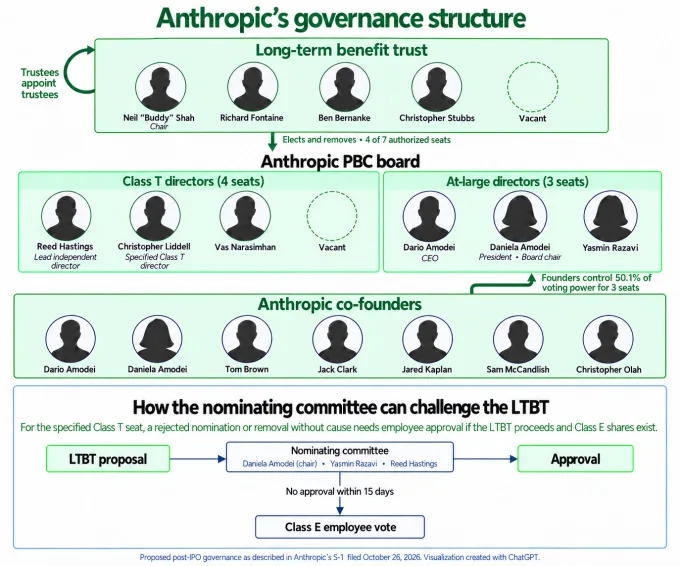
Image: Image Credits:Tim Fernholz/TechCrunch · Source
Anthropic’s IPO introduces an intricate governance framework prioritizing AI safety through a public benefit company model, founder voting power, and a Long-Term Benefit Trust, limiting influence of public shareholders in major decisions.
Anthropic, an AI safety startup founded in 2021, is preparing for its initial public offering (IPO), revealing a highly complex governance structure designed to maintain long-term control over the company’s direction and uphold its mission to prioritize humanity’s benefit. Unlike standard public companies, Anthropic’s governance limits the influence of ordinary public shareholders and focuses control within founders and specialized governance bodies.
As a public benefit corporation, Anthropic legally balances a social mission alongside profit motives. This status empowers its board to make AI safety-related decisions that may not align directly with shareholder profits without risking litigation from investors. The current board includes President Daniela Amodei, CEO Dario Amodei, Reed Hastings (Netflix cofounder), Christopher Liddell (former Microsoft and GM CFO), Novartis CEO Vas Narasimhan, and Spark Capital’s Yasmin Razavi, with one vacancy remaining.
Central to Anthropic’s control is a Long-Term Benefit Trust (LTBT), an independent entity tasked with safeguarding the company’s public mission. The LTBT holds a class of stock granting it majority authority over board appointments through Class T directors. The trust’s members are distinguished figures such as former Federal Reserve Chair Ben Bernanke and experts from global health and national security, with the panel itself selecting new members.
Additionally, the seven founders hold a special stock class conferring them 50.1% of shareholder voting power collectively, enabling them to elect a third of the board members. This founder control persists unless unanimity dissolves, in which case founder shares vote alongside regular shareholders.
Further checks exist: the board’s nominating committee can challenge LTBT decisions on certain director appointments by empowering employees to vote, embedding employee influence into governance.
This layered structure resembles and formalizes dynamics seen in organizations like OpenAI, where employee loyalty balanced board power. While founders initially retain firm control, their special voting rights expire ten years post-IPO or if their majority dissolves. Afterward, the LTBT remains until overwhelmingly ended by common shareholders, at which point control passes to usual shareholders.
Anthropic’s intricate governance is a deliberate design to ensure AI safety remains the corporate priority, constraining public investor influence. This approach signals the company’s intent to steer AI development responsibly despite going public, but it may complicate traditional shareholder engagement and oversight.
Sources and original reporting
Read the original source ↗
Comments (0)
No comments yet. Start the discussion.
Write a comment
Comments are published after moderation. Your name and comment will be visible publicly. Account