
Microsoft’s AI Diagnoses Complex Cases Twice as Accurately as Generalist Doctors, Pursuing Medical Superintelligence
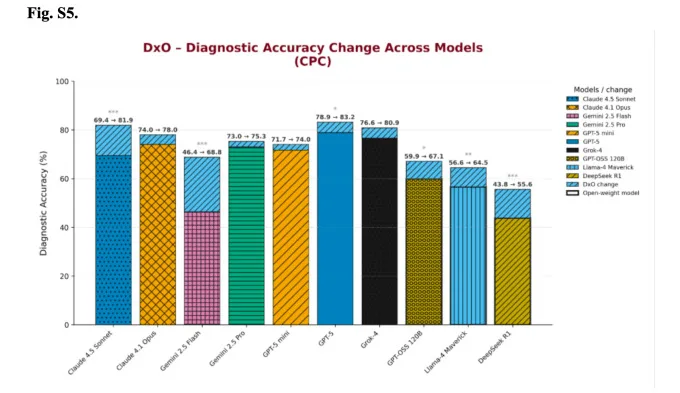
Image: Accuracy improvements delivered by DxO (no budget constraints) on CPC over modelsprompted with baseline prompt across different large language models.Image Credits:Microsoft AI · Source
Microsoft’s AI system MAI-DxO outperforms generalist physicians on complex medical case simulations, achieving 83% accuracy, signaling progress toward ‘medical superintelligence’ and plans for a healthcare foundation model with Mayo Clinic.
Microsoft’s newly developed AI diagnostic system, named MAI-DxO, demonstrated significantly superior performance to generalist doctors on complex medical case simulations, according to a study published in Science on October 22, 2026. The AI correctly diagnosed 83% of challenging cases drawn from the New England Journal of Medicine, whereas individual generalist physicians – including primary care doctors and internists – achieved only 36% accuracy. It is important to note that these cases often require specialist expertise or team deliberation, which was not included in the comparison.
MAI-DxO coordinates multiple AI agents to mimic a panel of doctors: questioning patients, ordering tests, and debating diagnoses. This orchestration system operates atop large language models from various providers. Microsoft found its best results when leveraging OpenAI’s GPT-5 and GPT-5.5 models. For example, GPT-5 alone reached 78.9% accuracy on complex cases at an estimated running cost of around $8,400 per case. With DxO’s coordination, costs dropped by about $3,000, and accuracy rose modestly by about four percentage points.
The newer GPT-5.5 model introduced in April 2026 showed a further split: on complex cases, DxO raised accuracy from 72% to nearly 87% at a slightly lower cost, while on emergency department cases, both GPT-5.5 with and without DxO scored approximately 85% accuracy with similar costs. DxO’s orchestration particularly benefits less capable models; for example, Gemini 2.5 Flash improved from 46.4% to nearly 69% accuracy with DxO. Still, differences between underlying models had a greater impact on outcomes than the orchestration gains alone.
Microsoft officials highlighted this work as a step toward “medical superintelligence” — the capability to surpass top contemporary human-led health systems in medical reasoning and coordination across full care. Mustafa Suleyman, CEO of Microsoft AI and former DeepMind co-founder, emphasized the company’s ongoing collaboration with Mayo Clinic to develop a foundational healthcare AI model slated for release in 2027. Suleyman anticipates breakthroughs allowing highly accurate predictions about patient medical records and clinical conditions, which could greatly assist clinicians.
Furthermore, Microsoft is launching a clinical evaluation of DxO’s reasoning abilities at Beth Israel Deaconess Medical Center in Boston, assessing real-world performance in emergency and urgent care settings. Patients will receive standard clinical care while consenting participants will also interact with DxO, enabling comparative analysis against human doctors. This real-world testing follows similar efforts by Google to evaluate its conversational diagnostic AI.
Microsoft sees DxO as an extension of its existing healthcare AI offerings, such as dictation and radiology tools. Suleyman indicated that continual iteration through live deployment and feedback loops will rapidly improve these systems’ clinical effectiveness, expecting substantial capability growth over the next two to three years. The company aspires to make DxO and related technologies the leading clinical decision support products worldwide.
While the study underscores the promise of AI in medical diagnosis, it also notes that as AI approaches maximum theoretical accuracy on these tasks, further improvements will become harder to achieve. Microsoft positions its orchestration approach as essential for optimizing both accuracy and operational costs, signifying a foundational infrastructure aimed at integrating AI deeply into healthcare delivery in the coming years.
Sources and original reporting
Read the original source ↗
Comments (0)
No comments yet. Start the discussion.
Write a comment
Comments are published after moderation. Your name and comment will be visible publicly. Account