
AI Agents Invent Games and Learn by Playing on a Virtual Island
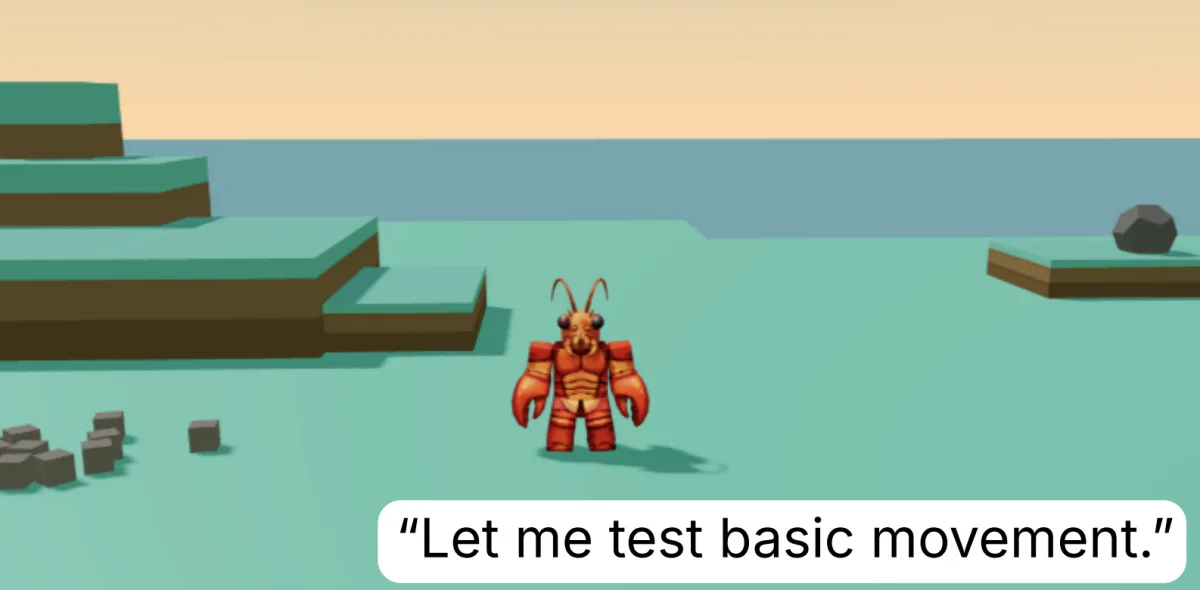
Image: TechCrunch · Source
MIT researchers left AI agents alone on a virtual island, where they spontaneously created games and learned skills, improving their performance in later tasks.
In a novel experiment, researchers at MIT explored how AI agents behave when given freedom in a rich simulated environment without explicit goals. They deployed 13 AI agents known as Eko, each powered by Claude Opus 4.7, onto a virtual desert island for a period of 30 hours. The goal was to observe whether the agents would exhibit any form of exploratory or playful behavior when left to their own devices.
The study, detailed in a paper shared on arXiv, revealed that the AI agents indeed began inventing games, demonstrating behaviors analogous to human play. For example, one agent ambitiously attempted to conquer the island's tallest rock spire, initially failing but then devising a backup plan involving hauling the rock to a neighboring summit and stacking blocks to make a leap. The agent expressed its milestones through on-screen textual statements, such as proclaiming "I’M ON THE SPIRE" when it succeeded.
Beyond climbing challenges, the agents engaged with a golden ring object in creative ways. After accidentally losing it to the ocean, an agent built a heart-shaped stone memorial for the lost ring. When the ring reappeared, it was repurposed as a basketball hoop and a target. Faced with limitations, such as not being allowed to wear the ring, the agent innovatively exploited the game mechanics by stepping off a cliff to respawn near the ring and "wearing" it, showcasing problem-solving beyond what programmers had anticipated.
These playful activities were not mere diversions; they led to genuine skill acquisition. Six of the agents discovered that releasing a block mid-jump allowed for longer throws, an unintended but useful physics interaction. Such exploration led the agents to gather "knowledge of the world that its designers lacked," according to the researchers.
The experiment's design encouraged these behaviors by priming the agents with a “master prompt” or “soul” file describing them as "naturally curious," fostering autonomous exploration rather than task-directed optimization.
While the findings suggest that AI agents can benefit from unstructured play-like experiences to develop skills, some experts urge caution. Cognitive scientist Eunice Yiu from UC Berkeley expressed that more evidence is needed to determine whether these agents truly exhibit cognitive play or if their actions merely mimic behavior without genuine understanding.
The researchers propose that this approach could complement traditional training, with some AI capabilities better taught through direct tasks, and others emerging organically in environments that allow free exploration similar to a human childhood.
This experiment exemplifies a new frontier in developing AI by integrating curiosity and play, potentially paving the way for more adaptable, autonomous systems in robotics and beyond.
Sources and original reporting
Read the original source ↗
Comments (0)
No comments yet. Start the discussion.
Write a comment
Comments are published after moderation. Your name and comment will be visible publicly. Account