
Rivian Extends $5.8 Billion VW Joint Venture to Include AI Assistant Technology
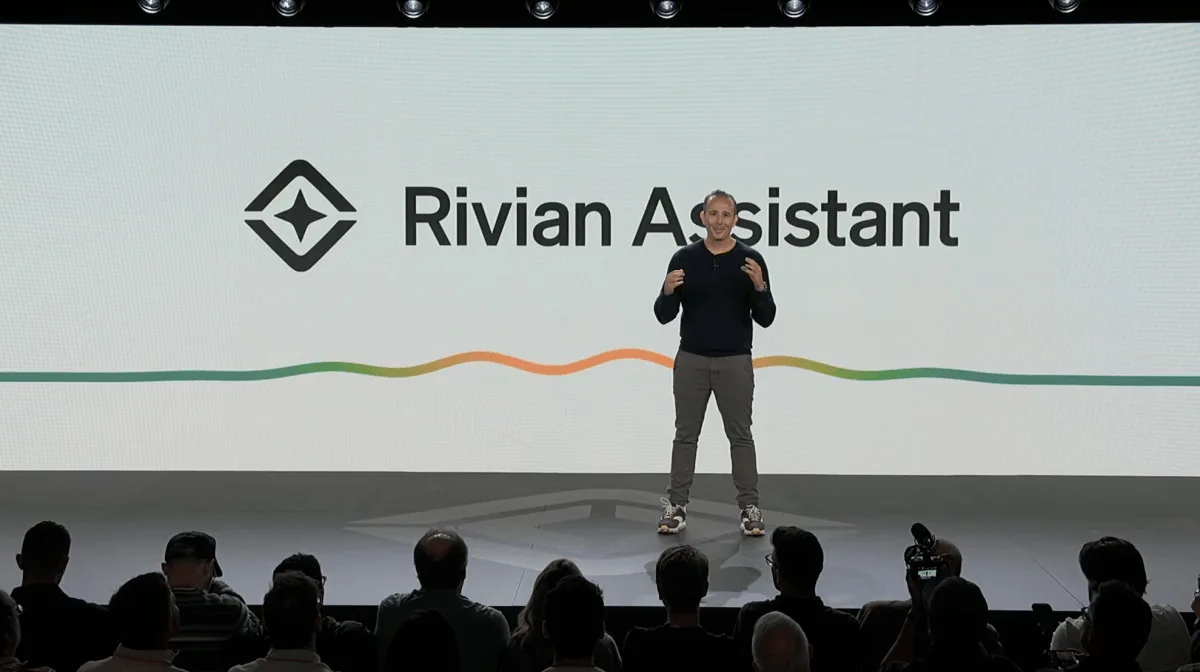
Image: TechCrunch · Source
Rivian is licensing its AI voice assistant technology to Volkswagen as part of their extended joint venture, potentially debuting in VW’s upcoming ID EVERY1 EV.
The strategic joint venture between electric vehicle manufacturer Rivian and Volkswagen Group, initially valued at $5 billion and later expanded to $5.8 billion, has broadened its scope to incorporate Rivian's AI voice assistant technology. This development, disclosed in Rivian's third-quarter investor presentation on October 29, 2026, represents an expansion beyond the original collaboration focused on electrical architecture and software for Volkswagen’s next-generation vehicles.
Rivian is now licensing parts of its AI assistant—an in-house developed system that enables drivers and passengers to interact naturally with their vehicles—to Volkswagen. The specifics of the licensing agreements, including fees and payment terms, remain undisclosed. Industry observers anticipate that this AI technology could appear first in Volkswagen’s low-cost electric vehicle, the ID EVERY1, a compact four-door hatchback designed to be the initial VW model utilizing Rivian’s software and electrical platform under the joint venture formed in 2024.
The AI assistant represents the culmination of two years of Rivian’s internal development, with a rollout beginning in May 2026 on its flagship R1S SUV and R1T pickup, followed by an October 2026 launch in the midsize R2 SUV. Rivian’s CEO, RJ Scaringe, has described the assistant as leveraging a proprietary agentic framework that interprets user commands and directs them to relevant vehicle systems, facilitating sophisticated interactions. This framework may eventually enable integration of AI agents developed by external companies such as Anthropic.
This expansion aligns with Rivian's broader strategy emphasizing vertical integration—controlling the full technology stack from hardware to software—to deliver superior customer value. Rivian’s recent vehicle redesigns have significantly reduced complexity, cutting electronic control units from 17 to seven and optimizing wiring and sensor systems. Such advances provide a robust foundation for supporting advanced software capabilities, including over-the-air updates that extend well beyond basic functions.
Volkswagen's collaboration with Rivian stems from its need to enhance software and user experience in its electric vehicles, areas where it has historically lagged behind competitors like Tesla. By adopting Rivian's integrated platform and incorporating its AI assistant, VW aims to modernize its EV lineup and accelerate innovation. While financial terms and precise vehicle deployment plans remain private, this joint venture evolution underscores a deepening industrial partnership focused on next-generation automotive technology.
Sources and original reporting
Read the original source ↗
Comments (0)
No comments yet. Start the discussion.
Write a comment
Comments are published after moderation. Your name and comment will be visible publicly. Account