
Hundreds of Publicly Exposed AI Hacking Tools of Artex Raise Cybersecurity Concerns
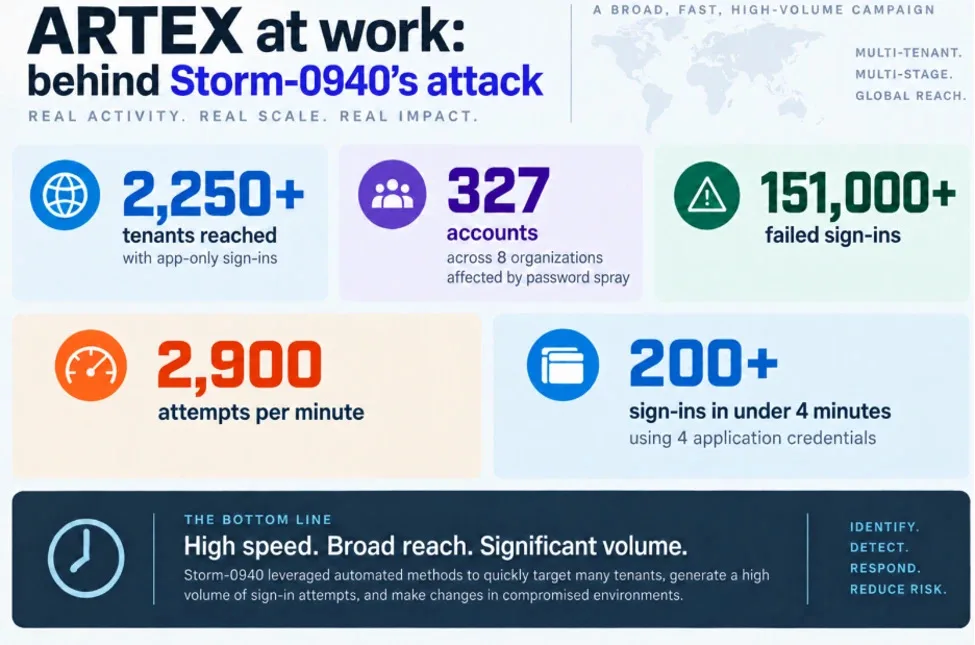
Image: Infographic showing Storm-0940’s high-speed cyberattack: 151,000+ failed sign-ins, reaching 2,250+ tenants and affecting 327 accounts across eight organizations, with over 2,900 attempts per minute and over 200 sign-ins in under 4 minutes using 4 app · Source
Security researchers have found over 800 publicly accessible instances of the open-source AI hacking tool Artex exposed on the internet. This accessibility risks misuse by cybercriminals amid ongoing large-scale attacks linked to the tool, including a major supply chain breach.
In a recent cybersecurity revelation, security researchers identified more than 800 publicly accessible deployments of Artex, a Chinese-developed open-source autonomous AI penetration testing tool. These instances were found exposed on the internet without password protection, allowing anyone unrestricted access to the powerful hacking software.
Artex is designed to autonomously probe computer systems for vulnerabilities, conducting comprehensive penetration tests with minimal human intervention. Released in July 2026 as open-source software, Artex quickly gained traction among cybersecurity professionals who lack access to elite proprietary AI models. However, it has also been linked to several large-scale cyberattacks, including breaches targeting the Korean finance sector and the IT support company ConnectWise.
The cybersecurity firm Censys uncovered the wide exposure of Artex deployments. Silas Cutler, a principal security researcher at Censys, noted that while some Artex instances are used legitimately by authorized testers, the vast number of exposed versions poses a significant risk. The software itself does not require internet-exposed deployment, suggesting many instances are misconfigured.
The exposure amplifies the risk of malicious use, as cybercriminals can easily find and operate these hacking tools without restriction. Some of these publicly accessible servers host implants—hidden malicious software components facilitating ongoing unauthorized network access.
Microsoft's analysis implicates the China-aligned threat actor Storm-0940 in using Artex to automate extensive cyber campaigns beginning in September 2026. Storm-0940 leveraged Artex's capabilities to rapidly scan and exploit vulnerabilities across hundreds of organizations worldwide, spanning sectors such as aerospace, defense, finance, manufacturing, and technology. Notably, the actor accelerated attacks during the October 2026 ConnectWise supply chain compromise, gaining privileged access to victim cloud environments within hours.
The attacks frequently exploit basic security weaknesses like weak passwords and the absence of multi-factor authentication. Microsoft highlighted that while many unauthorized authentications were attempted, not all resulted in data breaches. Nonetheless, the misuse of Artex by this threat actor significantly increases the speed and scale of cyberattacks, making timely defense more challenging.
In response to the growing threat, Artex's developers announced plans to convert the tool from open-source to a closed-source model with paid access, though substantial code copies remain publicly available. Meanwhile, Microsoft recommends organizations rigorously monitor application credentials, investigate unusual sign-ins, enforce least privilege, and follow ConnectWise’s containment guidance.
This scenario underscores a critical cybersecurity lesson: even sophisticated AI-driven tools present severe vulnerabilities if misconfigured or mishandled, emphasizing the need for robust security hygiene alongside advanced threat detection to mitigate AI-powered cyber risks.
Sources and original reporting
Read the original source ↗
Comments (0)
No comments yet. Start the discussion.
Write a comment
Comments are published after moderation. Your name and comment will be visible publicly. Account