
Reducing Emissions from Battery Production by Cutting Demand

Image: Ars Technica · Source
A study highlights that while making lithium-ion batteries emits greenhouse gases, reducing demand through longer battery life and efficient use can lower emissions more than manufacturing improvements.
As the global energy transition accelerates, lithium-ion batteries become central to powering electric vehicles (EVs) and storing renewable energy. Despite helping to reduce emissions by replacing fossil fuels, producing these batteries themselves generates greenhouse gases. A new study led by Haiwei Zhou at the University of Melbourne examines how to minimize the environmental footprint of battery production.
Currently, battery manufacturing accounts for about 0.18 percent of annual global greenhouse gas emissions, a relatively small slice of the emissions pie. However, with the growing reliance on batteries for transportation and energy storage, this figure could increase over tenfold by 2050. The study explores strategies to reduce these emissions both by improving production and by managing demand.
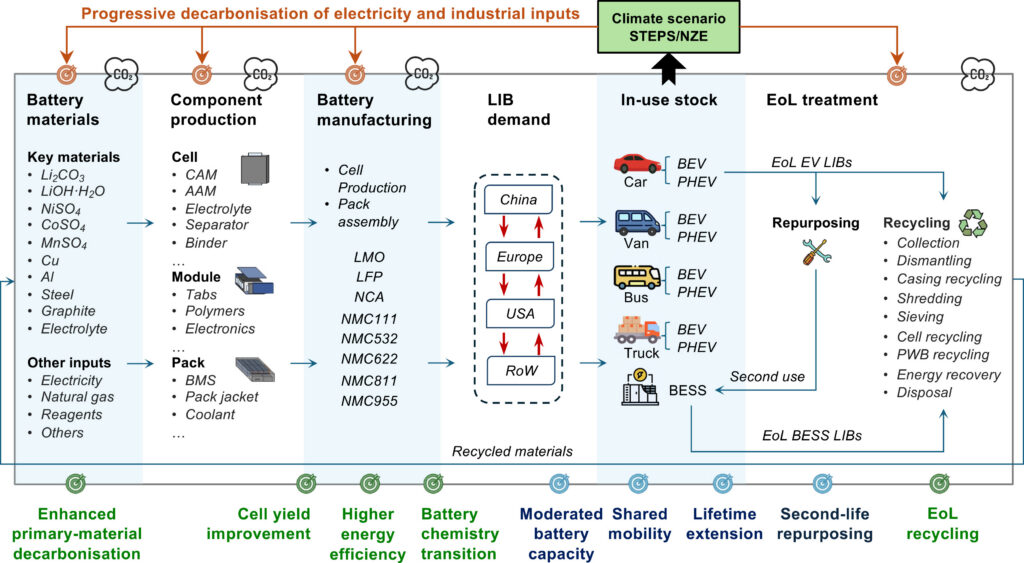
On the supply side, the study identifies several approaches: selecting battery chemistries with lower energy-intensive materials, enhancing energy efficiency throughout manufacturing, and expanding recycling to reintroduce materials with less energy input than mining. These improvements could collectively reduce the carbon footprint of each battery by 34 percent by 2050, avoiding 3.5 to 4.7 billion tons of CO2 emissions between 2024 and 2050.
Importantly, the researchers highlight that demand-side strategies could yield even greater emission reductions by avoiding the need to produce as many batteries. Extending the lifespan of EV batteries to match the vehicles themselves could cut battery demand by 29 percent. Controlling the trend toward larger capacity batteries, driven by consumer preferences for longer driving ranges and bigger vehicles, could reduce demand by an additional 23 percent relative to current projections.
Other demand reductions could come from broader adoption of ride-sharing services, which might lower battery needs by nearly 10 percent, and repurposing retired EV batteries for stationary energy storage, contributing about an 8 percent reduction. Combined, these demand-side measures could prevent 6 to 7.2 billion tons of CO2 emissions from 2024 to 2050, outperforming gains achievable through manufacturing improvements alone.
Though battery production currently makes up a small portion of global emissions—estimated at 38 billion tons of CO2 from fossil fuels in 2025—comprehensive net-zero strategies must address these smaller contributors. The study underscores that the most effective way to reduce emissions associated with batteries is by producing fewer of them through efficiency and innovation in use.
Efforts to clean electricity generation, plus cleaner battery production and smarter use, all play vital roles. Yet ultimately, the battery never made results in zero emissions, making demand reduction a powerful lever in the broader climate strategy. This insight guides a holistic approach to electrification as a climate solution, embracing both technological advancement and behavioral change to minimize environmental impact.
The study is published in One Earth, volume 2026, DOI: 10.1016/j.oneear.2026.101863.


Sources and original reporting
Read the original source ↗
Comments (0)
No comments yet. Start the discussion.
Write a comment
Comments are published after moderation. Your name and comment will be visible publicly. Account