
Rocket Lab Delays Neutron Rocket Launch to 2027 Due to Carbon Composite Manufacturing Issue

Image: Ars Technica · Source
Rocket Lab's Neutron rocket first flight is postponed to 2027 because of manufacturing defects in its large carbon composite propellant tank structures, which required process redesign and investigation to ensure safety and reliability.
Rocket Lab, known for its Electron launch vehicle, has officially delayed the inaugural flight of its medium-lift Neutron rocket to 2027. The postponement arises from a manufacturing defect discovered in the rocket’s carbon composite structures, specifically in the domed ends of the first stage propellant tanks. Announced initially in 2021 with an expected launch in 2024, the Neutron’s development timeline has now doubled, highlighting challenges in scaling up advanced materials for large launch vehicles.
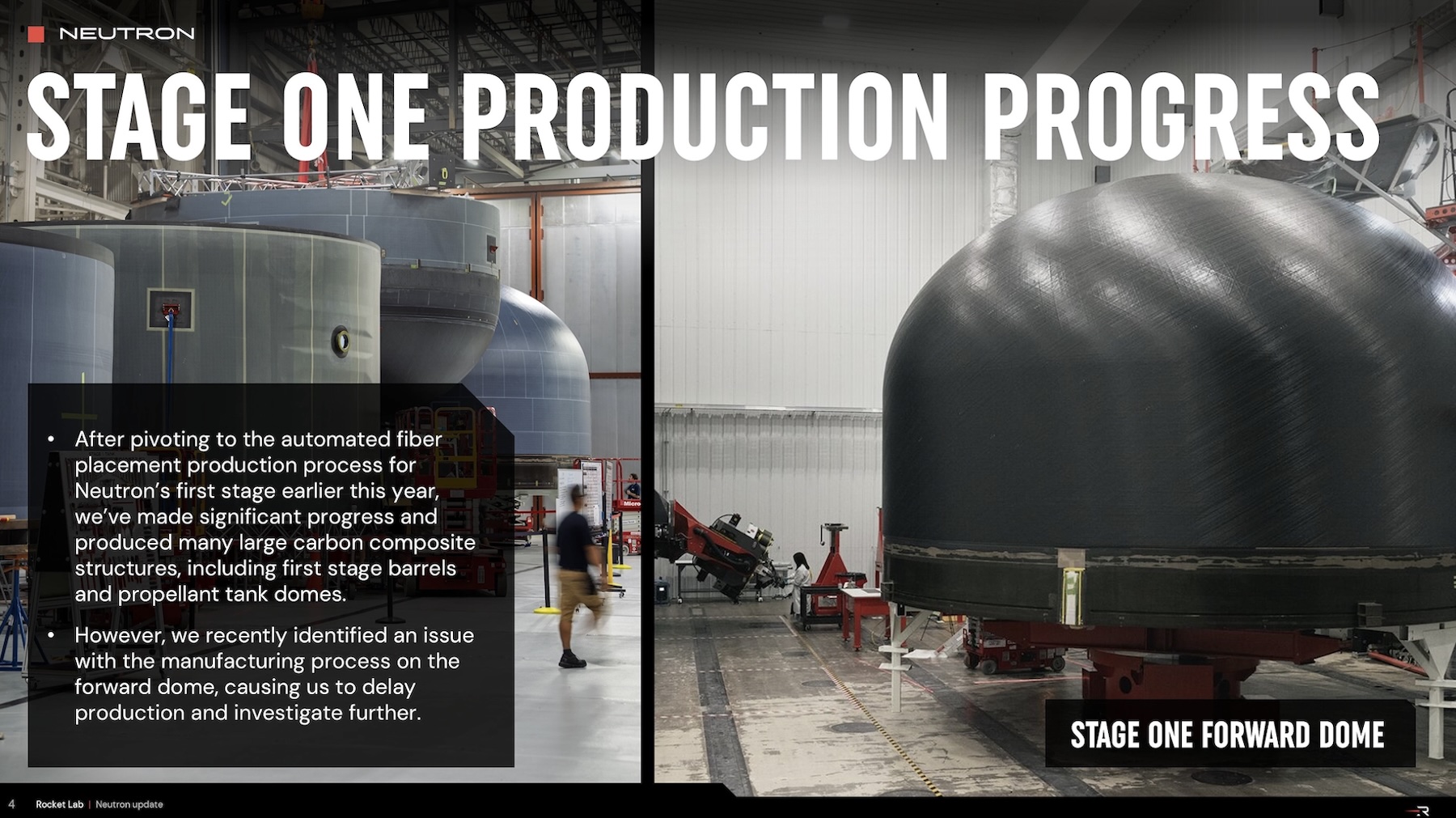
The Neutron rocket’s first stage is notable for its size—it comprises the largest pressurized carbon composite structures ever built, reaching a diameter of 23 feet (7 meters). These composite tanks offer benefits of low weight and high strength but are notoriously difficult to manufacture, especially because their size exceeds autoclave capacity. Autoclaves are high-pressure thermal curing chambers conventionally used to bond carbon fiber layers securely. Instead, Rocket Lab had to develop novel out-of-autoclave curing methods tailored to these massive components.
During routine inspections, engineers found voids—air pockets—between layers of carbon fiber in a recently cured forward dome. These defects, which can compromise structural integrity, appeared after a design change intended to reinforce the tanks following a rupture in an earlier test. The rupture itself was traced to a manual manufacturing defect in a critical join.
Rocket Lab’s CEO, Peter Beck, stated that these voids do not conclusively mean failure in flight, but the company prioritizes appropriate safety margins and thus paused production to investigate and resolve the issue. After modifying the manufacturing process, an aft dome built using the updated approach passed inspection, allowing the company to regain confidence and resume forward dome production.
Aside from structural challenges, Rocket Lab is still working to complete qualification testing for Neutron’s first stage and its methane-fueled Archimedes engines, which power the reusable booster stage. The Neutron rocket features a unique launch architecture where the upper stage and payload rest inside the first stage’s clamshell-like nose cone, which opens shortly after liftoff to release the upper section before the booster returns to a sea platform for recovery and reuse.
Rocket Lab aims for high reliability, with founder Beck emphasizing a goal to reach orbit on the first attempt, avoiding failure modes only discoverable during flight. The company has amassed robust operational experience with its smaller Electron rocket, which has completed 97 launches including 56 consecutive successes.
The Neutron rocket is designed to lift nearly 29,000 pounds (13,000 kilograms) to low Earth orbit, positioning Rocket Lab to compete for larger satellite payload and military contracts amid a growing demand for medium-lift launchers. Market pressures come as SpaceX transitions its commercial focus to the Starship vehicle, retiring Falcon 9 in the mid-term, opening opportunities for providers like Rocket Lab and other competitors such as Relativity Space, Stoke Space, and Firefly Aerospace.
Rocket Lab continues to build infrastructure alongside the rocket to enable rapid scaling and address the anticipated global launch demand. Although facing technological hurdles, the company remains focused on thorough ground validation before flight, underscoring a cautious yet ambitious approach to entering the medium-lift launch market with Neutron.


Sources and original reporting
Read the original source ↗
Comments (0)
No comments yet. Start the discussion.
Write a comment
Comments are published after moderation. Your name and comment will be visible publicly. Account