
Scientists Discover New Hexagonal Ice Form at Over 2 Million Atmospheres Pressure
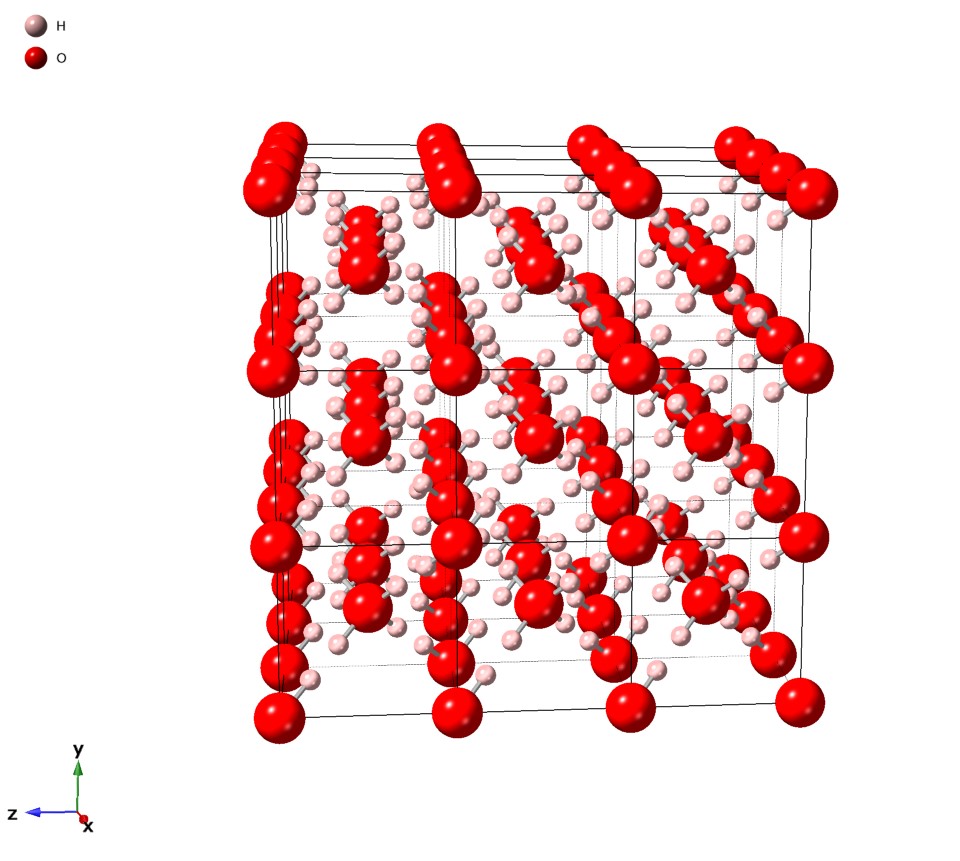
Image: Illustrative image · Ms2895 · CC BY-SA 4.0 · Source
Researchers have experimentally observed a hexagonal close-packed (HCP) phase of ice that dominates at pressures above 200 GPa and temperatures above 1800 K, challenging previous assumptions of only cubic ice XVIII in this range.
An international team of physicists has for the first time experimentally identified a hexagonal close-packed (HCP) phase of ice, which becomes the predominant form at pressures exceeding 200 gigapascals (approximately 2 million atmospheres) and temperatures over 1800 kelvins. Prior to this discovery, only the cubic face-centered (FCC) oxygen layer packing—known as ice XVIII—was observed under these extreme conditions.
To simulate the high-pressure, high-temperature environment, researchers employed a diamond anvil cell to compress a water sample within an extremely small volume while heating it with lasers. The ice structure was analyzed via synchrotron X-ray diffraction techniques. The HCP phase was found to dominate above 200 GPa and near 2000 K. In intermediate pressure ranges, a coexistence of HCP and FCC crystalline structures was detected.
Water is unique in its ability to form multiple solid phases distinguished by different atomic arrangements in their crystal lattices. The HCP and FCC phases are variations of dense atomic packing with differing stacking sequences—ABAB for hexagonal and ABCABC for cubic—rather than typical ice crystals. This indicates different physical states of water under such extreme pressures and temperatures.
The revelation of HCP ice is significant for planetary science, particularly for refining models of the interiors of ice giant planets like Uranus and Neptune. Direct probing of these planets’ inner layers is not feasible, so researchers rely on experimental data and physical modeling. The new findings suggest that oxygen atomic layers may stack in hexagonal sequences deep inside, potentially altering mechanical and electrical properties compared to cubic ice.
These structural differences could impact the understanding of the mantle stratification and the unusual, non-dipolar magnetic fields observed in these planets. The researchers note that theoretical investigations into the plasticity and electrical conductivity of hcp ice are now necessary, alongside further experimental efforts to precisely define the stability ranges of both HCP and FCC phases of ice under such extreme planetary conditions.
Sources and original reporting
Read the original source ↗
Comments (0)
No comments yet. Start the discussion.
Write a comment
Comments are published after moderation. Your name and comment will be visible publicly. Account