
Scientists Reconstruct the Sound of the Liberty Bell Using Modal Analysis of a Replica

Image: Ars Technica · Source
Researchers at Penn State analyzed a 20th-century replica of the Liberty Bell to estimate its original acoustic properties, revealing its modal frequencies and shedding light on its historic sound before the iconic bell cracked irreparably.
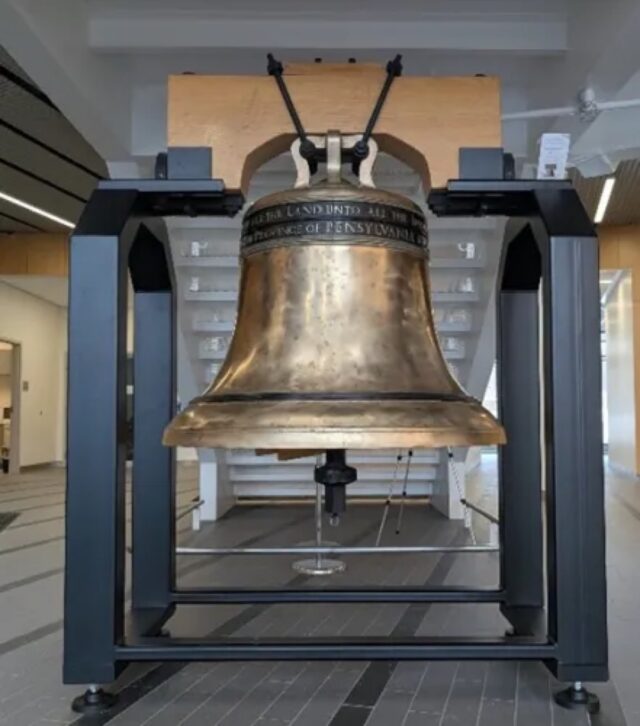
The Liberty Bell, renowned for its historic symbolism and famous crack, has not been rung for about 180 years. Despite this, researchers have long wondered what the bell originally sounded like when rung. In a recent scientific effort aligned with the United States' 250th anniversary celebrations, a team at Penn State University conducted modal analysis on a 20th-century full-scale replica of the Liberty Bell located at the Penn State Behrend campus to explore its acoustic characteristics.
The original Liberty Bell suffered its infamous crack sometime between 1817 and 1846, rendering it silent after an attempt to ring it in 1846 further enlarged the fissure, effectively ending its functional use. Historical data confirm it had earlier cracked shortly after its arrival in Philadelphia in 1752, leading to two recastings by local foundry workers John Pass and John Stow to restore its tone and integrity. The second recasting was successful enough for the bell to be used for notable public purposes until the post-Revolutionary War era.
Previous studies noted the bell’s composition produced an extremely brittle alloy of metals, contributing to crack formation and making it susceptible to damage over time. Typical bronze bells produce sound based on their shape and material properties, which influence vibrational modes and tuning.
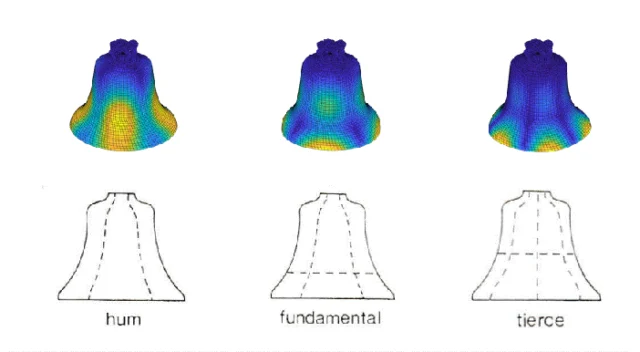
The Penn State research team—Sean Collier, Jon Young, and Aaron Stearns—used precise instruments such as accelerometers and force gauges to capture how their replica bell vibrated when tapped. This experiment allowed them to measure the bell’s natural frequencies, mode shapes, and energy loss factors accurately. Their findings identified key modal frequencies: a hum note at 174 Hz, fundamental frequency at 323 Hz, tierce at 381 Hz, quint at 510 Hz, and nominal at 623 Hz. These frequencies closely matched idealized tuning ratios typical of Western church bells, which are often perceived musically as a minor triad and noted for a somber tone.
Because different casting methods and material compositions influence energy loss and sound quality, the team noted that the bronze alloy and casting processes differed between the 18th-century original and the 20th-century replica. Consequently, while the measured loss factors fell within typical ranges, directly translating these values to the original bell involved some uncertain variables.
This research advances historical understanding by combining physics and acoustic science to approximate a sound that has long been lost to history—the resonant ring of the Liberty Bell before its iconic crack ended its ringing. The study was presented at the Acoustical Society of America meeting and published in Physics Today in 2026, contributing valuable quantitative data to the legacy of this national symbol.


Sources and original reporting
Read the original source ↗
Comments (0)
No comments yet. Start the discussion.
Write a comment
Comments are published after moderation. Your name and comment will be visible publicly. Account