
Microsoft Surface Laptop Ultra: A Powerful ARM Laptop for AI and Gaming, but Software Support Lags
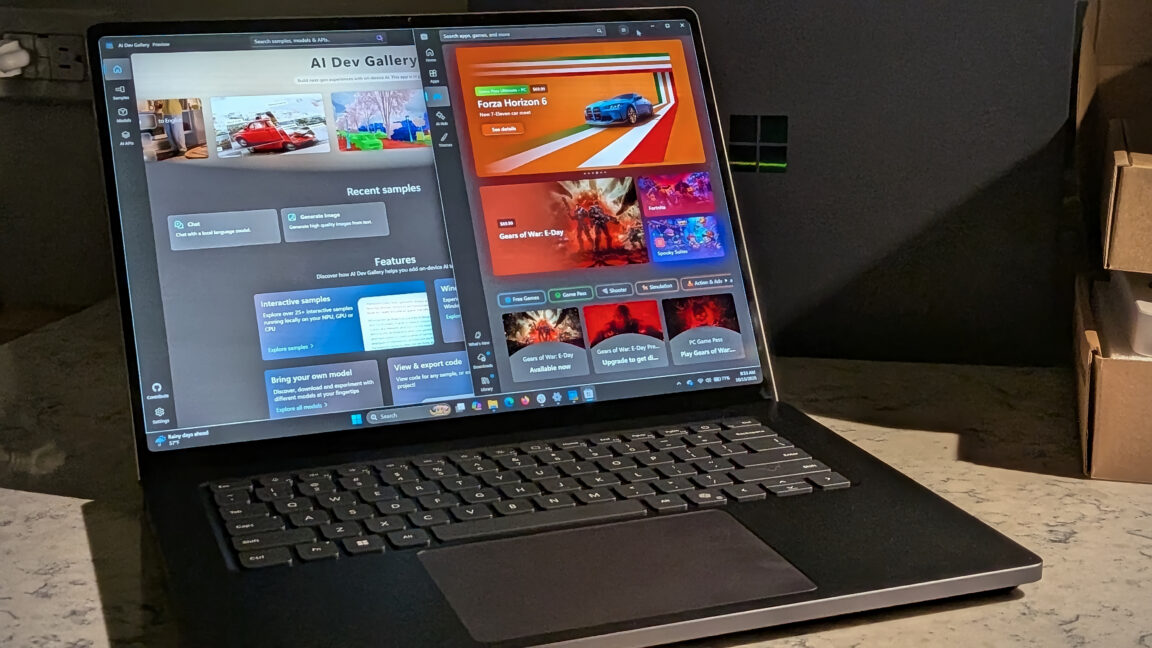
Image: Ars Technica · Source
Microsoft's new Surface Laptop Ultra boasts impressive ARM-based Nvidia RTX Spark hardware for AI and gaming workloads, with a premium display and design. However, key AI software features and full driver support are still forthcoming, making early adopters cautious.
Microsoft has launched the Surface Laptop Ultra, its most powerful Surface laptop to date, targeting developers, AI researchers, and gamers seeking an all-in-one portable solution. This 15-inch ARM-based laptop centers on the Nvidia RTX Spark platform, combining an ultra-efficient CPU with a powerful Nvidia Blackwell GPU designed to deliver up to a petaflop of AI compute and run AI models with up to 120 billion parameters locally.
The device features a stunning 3270×2180 mini-LED PixelSense display capable of 2000 nits peak brightness, delivering deep blacks and vivid colors suitable for gaming, video, and creative work. Its premium build includes an excellent keyboard comparable to top-tier laptops, a large haptic-feedback trackpad, and a magnetic USB-C charging port, a first of its kind in USB-C implementations offering easy, breakaway charging for safety.
Configurations start at $2,599 for 24GB of unified memory and scale up to nearly $6,000 for high-end specs with 128GB memory and advanced CPU/GPU cores. The unified memory architecture shares RAM between the CPU and GPU, beneficial for demanding AI and gaming tasks. However, the base 24GB model ships with Windows 11 Home, while higher-memory models come with Windows 11 Pro.
In testing, the Surface Laptop Ultra ran demanding AI workloads including a 70-billion-parameter large language model at an impressive 6.26 tokens per second on the GPU. It also handled AAA gaming titles such as Gears of War: E-Day smoothly with ray tracing and DLSS enabled, rivaling expectations for high-end portable gaming. The laptop delivered a blend of CUDA compute performance traditionally unseen in ARM laptops.
Despite the powerful hardware, the current ecosystem shows immaturity. Microsoft’s AI Dev Gallery preview app only supports CPU on most conversational models, and flagship offerings like Microsoft’s Phi Silica large language model require developer registration, limiting immediate consumer use. Key Copilot+ AI assistant features promised for this hardware are scheduled for late 2026 or early 2027, and current GPU encoding support is lacking in common video software.
Battery life varies with use but drains quickly under intense AI workloads, emphasizing the device’s performance-first design. The laptop also carries warnings about app compatibility, especially for software reliant on kernel-level anti-cheat or specialized drivers, due to its ARM architecture and emulation layer.
In summary, Microsoft and Nvidia's collaboration has delivered breakthrough ARM hardware that genuinely combines AI inference, development, and AAA gaming capabilities in one portable device. However, the supporting software stack and driver ecosystem are still catching up, currently limiting the laptop’s full potential. Early adopters with deep pockets and specific AI or gaming needs may find the Surface Laptop Ultra compelling, but mainstream users and those seeking guaranteed feature availability may prefer to wait for software maturity before switching from established platforms such as the MacBook Pro.
Photo gallery
Read the original source ↗
Comments (0)
No comments yet. Start the discussion.
Write a comment
Comments are published after moderation. Your name and comment will be visible publicly. Account