
Crows Process Visual Information Twice as Fast as Mammals, Study Finds
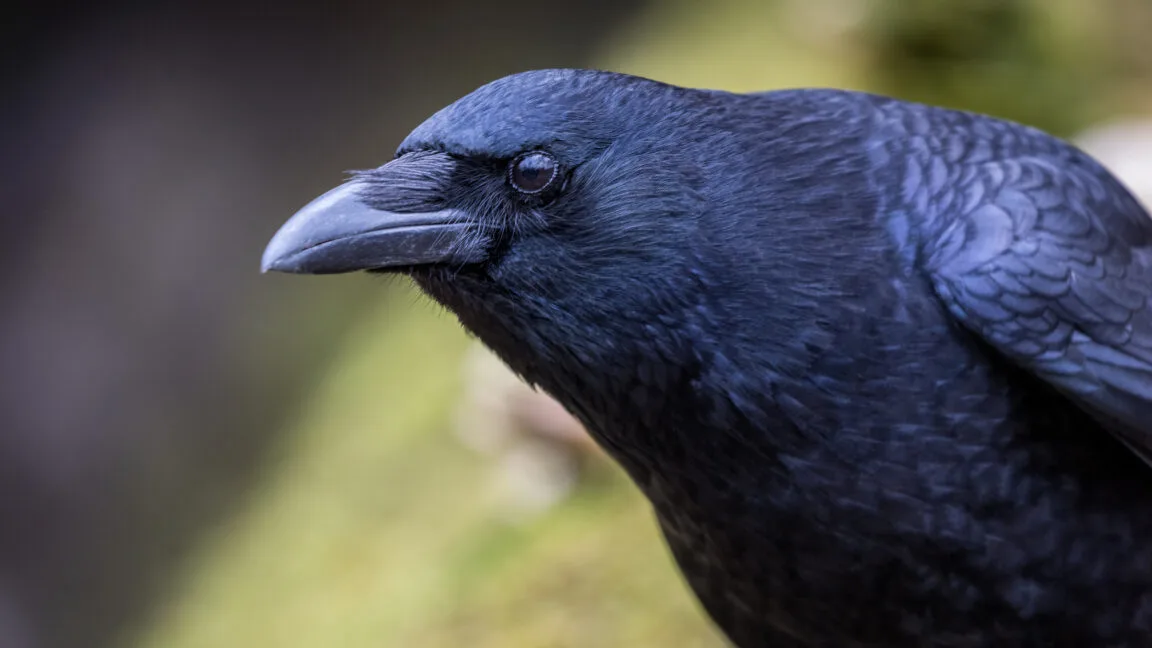
Image: Ars Technica · Source
Research shows crows can evaluate complex visual cues in about half the time it takes primates, despite having a different brain structure, highlighting unique evolutionary adaptations in avian cognition.
A recent scientific study has revealed that crows can process and evaluate visual information twice as fast as mammals, including primates, despite having a fundamentally different brain architecture. Researchers at the University of Tübingen investigated how crows perform a complex visual decision-making task known as the random-dot-motion task, commonly used to study decision-making in primates.
In this task, a subject views a cloud of dots moving in various directions and must determine the overall direction of motion. Two carrion crows were trained to indicate their choice by pecking on a touchscreen, while the researchers recorded the activity of neurons in the crows’ nidopallium caudolaterale (NCL), an area considered functionally analogous to the mammalian prefrontal cortex.
Despite diverging from mammals over 360 million years ago, and lacking the layered neocortex characteristic of primates, the crows used similar mathematical logic to accumulate sensory evidence before making a decision. Remarkably, crows made their decisions in approximately 235 milliseconds on average, compared to 400 to 600 milliseconds for monkeys under similar experimental conditions, and they maintained accuracy comparable to primates and humans.
The study found that about a quarter of recorded neurons in the NCL displayed activity reflecting the birds' choices, with decision-related signals emerging as early as 70 milliseconds after stimulus onset—well before the birds initiated pecking. This neural activity pattern is analogous to the decision variable signals observed in primate brains.
Lead researcher Andreas Nieder suggested the crows' speed arises from several physiological factors: the small size and dense packing of neurons allowing short axonal pathways, and their higher body temperatures (up to 41–42ºC) accelerating neuronal and chemical processes. These adaptations, likely driven by the demands of flight and the need for rapid sensory-motor responses, enable efficient processing in a compact avian brain.
While the findings highlight evolutionary convergence in decision-making mechanisms, the researchers caution that the study's sample size was small (two birds) and focused on highly intelligent corvid species. It remains to be seen whether these results generalize across other bird species or types of cognitive tasks.
This work, published in Science in October 2026, advances understanding of how different brain architectures can support rapid and accurate sensory decisions, underscoring unique neural adaptations in birds that enable them to thrive in complex environments.


Sources and original reporting
Read the original source ↗
Comments (0)
No comments yet. Start the discussion.
Write a comment
Comments are published after moderation. Your name and comment will be visible publicly. Account