
Quantinuum Demonstrates Quantum Error Correction Scaling Well Beyond Breakeven
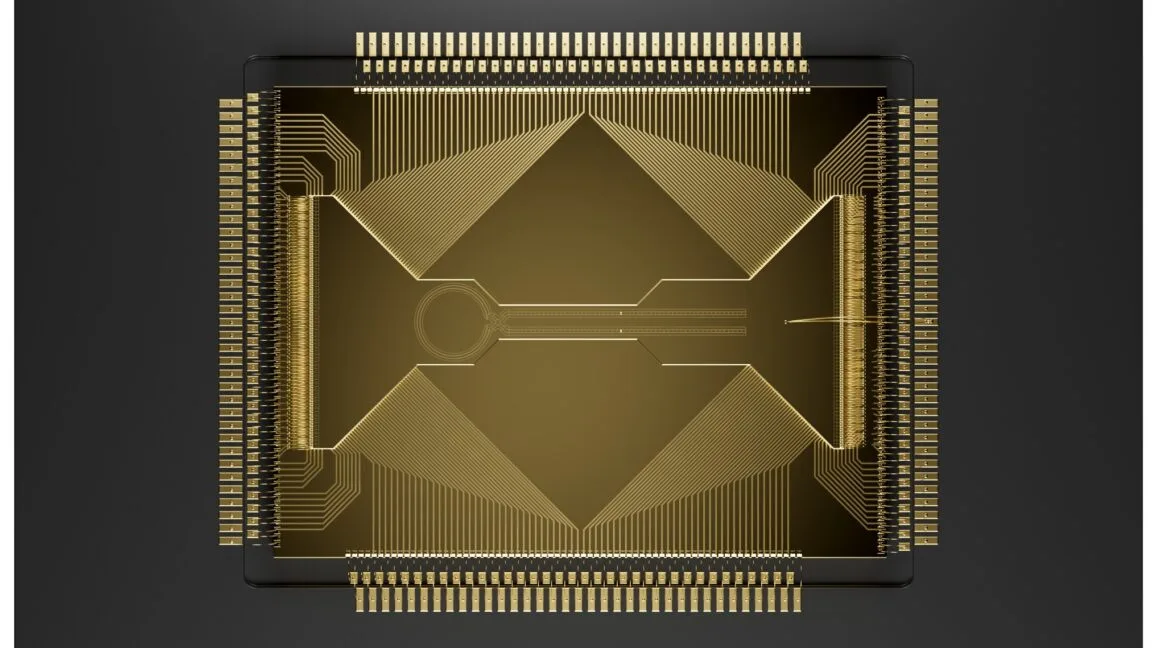
Image: Ars Technica · Source
Quantinuum's latest trapped-ion quantum processor significantly improves logical qubit error rates, achieving a tenfold reduction with each increase in error-correction code distance, marking a major advancement in quantum error correction performance.
Quantum computing faces a fundamental challenge: qubits are prone to errors from environmental noise and imperfect control. To reliably run quantum algorithms, these errors must be detected and corrected using logical qubits, which link multiple physical qubits through error correction codes. Scaling these logical qubits to lower error rates has historically met with limited success, as added hardware qubits increase complexity and can introduce more errors, hindering performance improvements.
Recently, Quantinuum, a leader in trapped-ion quantum computing, presented new results from its Helios processor that mark a significant breakthrough in quantum error correction scaling. Unlike prior systems demonstrating only modest improvements—error rates dropping by factors around two when increasing code size—Quantinuum's setup achieved approximately a tenfold reduction in logical qubit error rate with each step up in the error correction code distance.
The Helios system uses ions trapped and manipulated via electrical fields and lasers, allowing any two ions to be entangled, which supports versatile error correction codes. The company implemented color codes with distances of 3, 5, and 7, corresponding to progressively larger groups of hardware qubits (13, 37, and 73 qubits respectively). Testing these codes for quantum memory applications, where a logical qubit holds its state, showed error rates declining from about 5×10⁻⁴ at distance 3 to 5×10⁻⁶ at distance 7, indicating robust error suppression.
Key to this performance is Quantinuum's innovation in managing leakage errors—where qubits stray into unintended energy states—by applying targeted laser pulses that return these qubits to computational states, reducing leakage error rates by over six times. Additionally, their software dynamically swaps leaked data qubits with measurement qubits, enabling efficient error correction cycles.
The team also demonstrated the system's capability to run two-qubit logic gates within the logical qubits, a more demanding operation than storing quantum information. While a distance 3 code showed little improvement on gate error rates, the distance 5 code reduced errors substantially, underlining the hardware's ability to maintain low logical error rates during computation.
Though these achievements are promising, the system currently supports only one distance 7 logical qubit at a time, and the lowest error rates still exceed the thresholds needed for complex quantum algorithms. Nonetheless, the scaling trends suggest that further hardware improvements could yield dramatic gains in logical qubit reliability.
Quantinuum's progress signals that trapped-ion systems may soon reach the levels of error correction performance necessary for practical, large-scale quantum computing, provided the company can continue to scale qubit counts and maintain or improve hardware error rates. This contrasts with other quantum computing platforms that must simultaneously address error rates, qubit count, and system integration challenges. The Helios results thus represent a significant step forward in the quest for fault-tolerant quantum computers.

Sources and original reporting
Read the original source ↗
Comments (0)
No comments yet. Start the discussion.
Write a comment
Comments are published after moderation. Your name and comment will be visible publicly. Account