
New Modeling Suggests Mars Hosts Unique Ice-Forming Cloud Physics
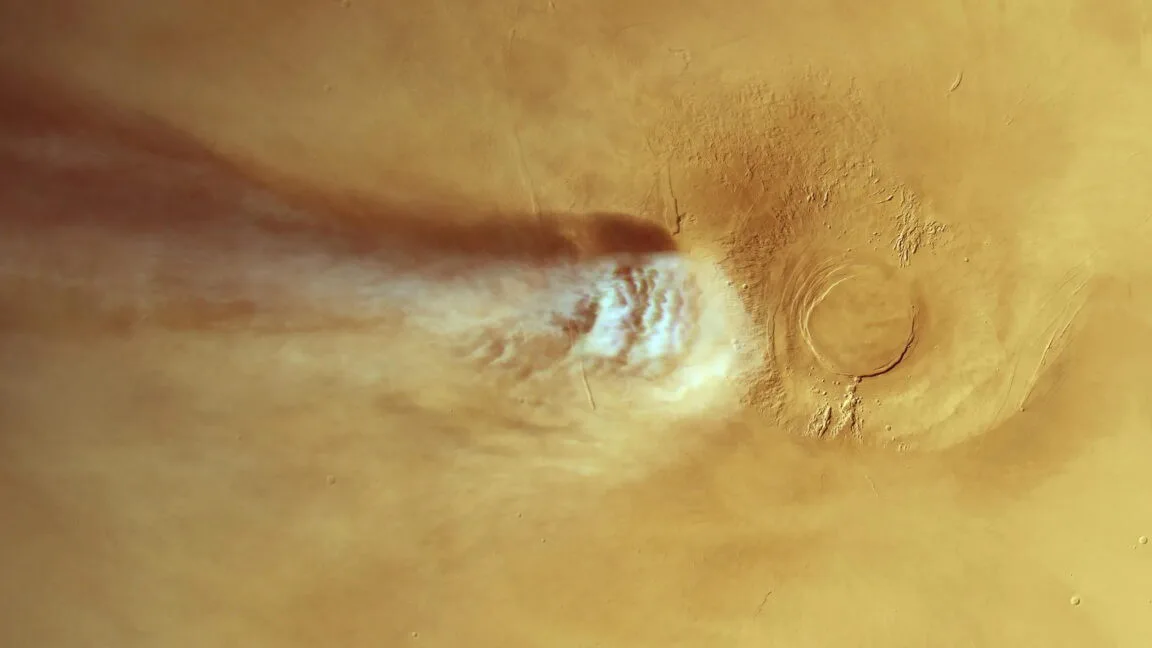
Image: Ars Technica · Source
Researchers modeled a mysterious 1,000-mile-long cloud on Mars, revealing rare atmospheric physics not previously observed in nature, involving direct ice formation without particles.
Each spring and summer morning on Mars, near the towering volcano Arsia Mons, a uniquely long and thin cloud forms, stretching over 1,000 miles before fading away. This cloud, known as the Arsia Mons Elongated Cloud (AMEC), has puzzled scientists since its discovery by a probe in 2018 due to its unusual size and persistence. Recent research led by planetary scientist Jorge Hernández-Bernal at Sorbonne Université has managed to simulate the cloud’s formation, revealing it arises from a rare physical process not previously observed in any planetary atmosphere.
Unlike Earth clouds, which typically develop when water vapor condenses onto dust or salt particles, the AMEC seems to form through homogeneous nucleation. This process allows water vapor in Mars’s atmosphere to turn directly into ice crystals without any particulate matter to initiate condensation. Hernández-Bernal described this as condensation occurring in open air rather than on surface interfaces, an unexpected and theoretically proposed phenomenon until now.
The formation requires extreme conditions: a rapid temperature drop of approximately 30°C within 10 minutes and extraordinarily high relative humidity—over 100,000 times greater than any humidity recorded on Earth. The massive Arsia Mons volcano plays a crucial role by generating powerful atmospheric waves as wind currents collide with its 65,000-foot peak, rapidly propelling moist air to high altitudes.
While scientists have speculated similar ice nucleation might happen in the upper atmospheres of planets like Venus or even Earth, no direct observation has proven this, mainly due to the extreme humidity conditions needed. This modeling provides new insight into Martian meteorology, indicating such extraordinary humidity levels actually occur there. The study, published in Nature Geoscience, marks a significant advancement in understanding Mars’s climate and atmospheric phenomena, highlighting physics previously regarded as purely theoretical and unseen in natural environments.
This discovery not only helps explain the persistent AMEC but also opens avenues to explore atmospheric processes on other planets under conditions much different from Earth’s. Given limited knowledge about Mars’s atmosphere compared to Earth’s, successfully replicating the cloud in simulations underscores the robustness and importance of this novel finding.

Sources and original reporting
Read the original source ↗
Comments (0)
No comments yet. Start the discussion.
Write a comment
Comments are published after moderation. Your name and comment will be visible publicly. Account