
Global Smartphone Sales Drop 20% in Q3, Lowest Since 2013
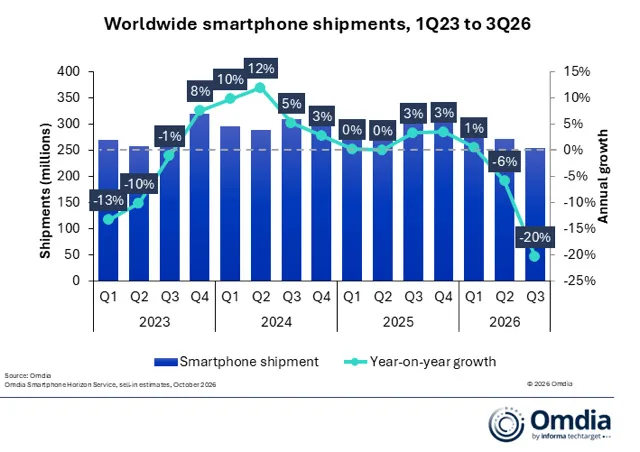
Image: A bar and line chart shows worldwide smartphone shipments from Q1 2023 to Q3 2026. Blue bars represent shipment volume in millions, whilst a teal line tracks the percentage of annual growth, with data labels indicating specific fluctuations over time · Source
Worldwide smartphone sales fell 20% year-on-year in Q3 2026 to 254.7 million units, the lowest volume for that period since 2013, impacted by higher prices and component shortages, according to Omdia.
Global smartphone sales declined sharply during the third quarter of 2026, with total shipments falling 20% year-on-year to approximately 254.7 million units. This represents the lowest quarterly volume since 2013, as reported by the consultancy firm Omdia.
The main factors driving this decline are rising device costs and ongoing shortages of key components, which have particularly affected consumer demand in emerging markets. Distributors and retailers have responded cautiously by limiting inventory replenishment ahead of the holiday season, constrained by increased capital requirements due to price hikes.
Regional performance varied significantly. Africa experienced the steepest sales drop at 39%, attributed to channel prioritization of higher margins and selective selling despite persistent underlying demand. Other regions such as Asia-Pacific (excluding Greater China), the Middle East, and Latin America also saw declines exceeding 20%. North America proved more resilient, supported by a strong premium segment and carrier-backed financing, trade-in, and upgrade programs.
Economic pressures including currency depreciation, inflation, and cost-of-living increases have reduced consumers’ purchasing power. Many have delayed new phone purchases or opted for refurbished smartphones and basic feature phones in lower-income markets.
Samsung maintained its position as the largest smartphone vendor, distributing 57.8 million units, a 5% decrease year-on-year. The brand’s Galaxy A series helped keep competitiveness in entry and mid-level segments, even as other Android manufacturers faced memory shortages and higher prices. Its August release of the Galaxy Z8 foldable series, coupled with trade-in and renewal offers, bolstered its premium market share.
Apple’s shipments remained stable at 56.5 million units, buoyed by sustained demand for the iPhone 17, notably in China and North America, and early channel stocking anticipating price increases. In September, Apple launched the iPhone 18 Pro, 18 Pro Max, and its first foldable, the iPhone Duo, postponing the iPhone 18 base model launch until 2027 to extend the iPhone 17’s sales lifespan and concentrate premium demand during the holiday period.
Chinese manufacturers faced sharper sales contractions. Xiaomi held third place with 30.7 million units, down 29%, from 20% and 28% declines in China and India respectively. It continued adjusting prices globally to defend margins amid higher component costs, impacting volumes especially in price-sensitive emerging markets. New models like Redmi A7 Pro and Redmi 17 provided some support but did not offset the overall downturn.
Oppo (including realme and OnePlus) ranked fourth with 23.4 million units sold, a 39% drop, followed by Vivo in fifth with 19.3 million units and a 33% decline. Both brands raised prices in main markets due to component cost inflation, complicating inventory planning.
Manufacturers of mass-market devices prioritized profitable markets and core product lines while component supply remained constrained. They adjusted configurations, reduced product variants, selectively absorbed costs, and expanded higher-value offerings to protect profitability.
Omdia forecasts a full-year smartphone sales decline of approximately 12%, expecting further price increases and limited discounting during the upcoming holiday season. Independent retailers appear most vulnerable due to slower inventory turnover and shrinking margins, potentially accelerating market exits.
Looking ahead to 2027, Omdia predicts a more moderate sales decline as persistent shortages of standard and high-bandwidth memory keep costs elevated. These findings broadly align with IDC’s data, which reports a 22% year-on-year decrease to 255.3 million units.
(Source: Mobile World Live report based on Omdia data)
Sources and original reporting
Read the original source ↗
Comments (0)
No comments yet. Start the discussion.
Write a comment
Comments are published after moderation. Your name and comment will be visible publicly. Account