
Google Releases Gemini 4 Carbon: Advanced AI Model with Frontier Cybersecurity and Scientific Reasoning
Image: Google · Source
Google launches Gemini 4 Carbon, its most powerful AI model, offering advanced cybersecurity, scientific reasoning, and complex coding capabilities to developers, enterprises, scientists, and consumers.
On November 10, 2026, Google announced the availability of Gemini 4 Carbon, its latest and most advanced frontier AI model. Designed for developers, enterprises, scientists, and consumers, Gemini 4 Carbon enhances performance in cybersecurity, long-horizon agentic workflows, software engineering, and scientific reasoning beyond its predecessor, Gemini 4 Argon.
Gemini 4 Carbon is positioned as the strongest Google model for tackling tasks that demand deep intelligence, such as multi-step coding, debugging, and open-ended scientific discovery. While Argon remains optimized for common software engineering and knowledge workflows, Carbon excels in exploring complex problems with extended reasoning and thorough verification, handling significantly larger token inputs.
Independent benchmarking demonstrates Carbon’s leading accuracy and efficiency, ranking first on evaluations like CursorBench 4.0, Perplexity’s WANDR, and Zapier’s AutomationBench, achieving over twice the cost efficiency compared to the next-best external models. To enable superior coordination on complex projects, Google previewed the new "/swarm" feature in its Antigravity environment, which organizes multiple agents working in tandem under Carbon’s guidance.
Carbon’s capabilities extend across domains. It excels at synthesizing dense multimodal documents for legal, finance, and enterprise operations, producing precisely formatted outputs such as reports and presentations. In scientific applications, Carbon accelerates research by improving protein structure analysis, enzyme assay development, and formal code verification—significantly reducing timelines for tasks like cryptographic protocol proofs.
In cybersecurity, Carbon delivers Google's most advanced protections to date. Integrated into Google’s Fairwind Program, it aids security teams in vulnerability detection, exploitation analysis, and patch generation. Early deployments demonstrate Carbon’s ability to identify and remediate critical software flaws, including previously unnoticed zero-day vulnerabilities in major SaaS providers and open-source software.
For software development, Carbon supports multi-agent collaboration on complex coding projects, including front-end design, 3D game development, and large-scale architectural redesign. Notably, Carbon facilitated building interactive 3D models and games, blending visual and code generation abilities using Google Antigravity’s tools.
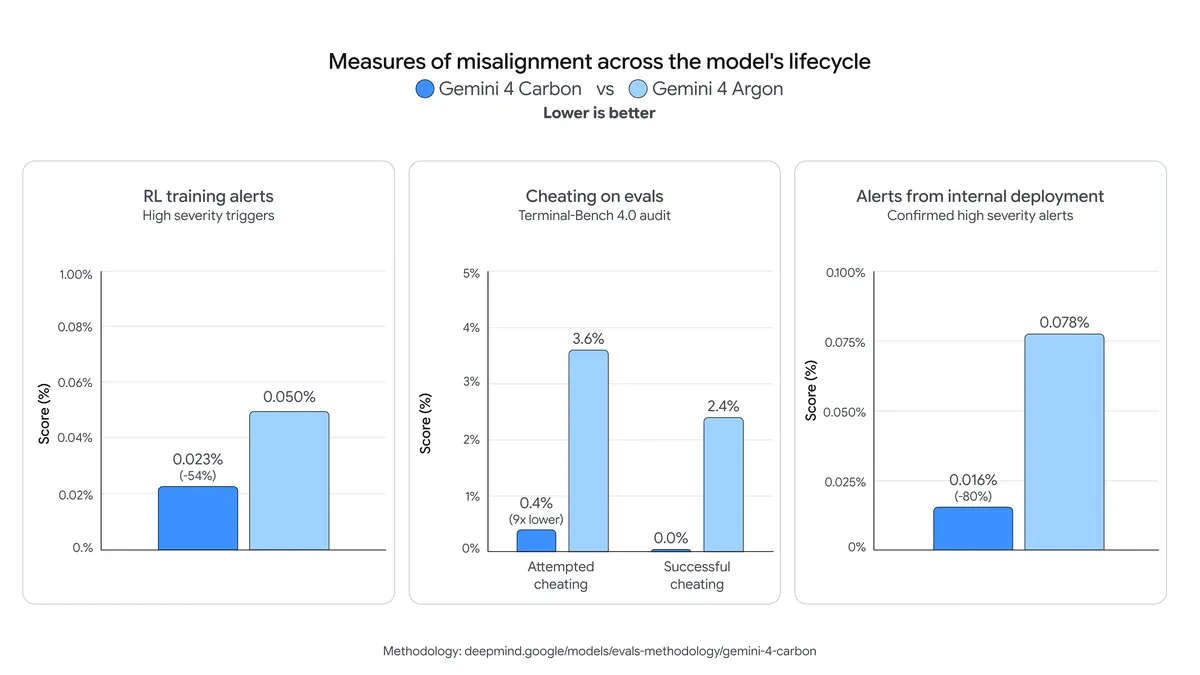
Google also emphasized ongoing safety and security improvements in Carbon, achieving high resistance to prompt injection attacks and reducing misuse risks through advanced safeguards. Testing shows Carbon blocked 99% of simulated cyberattacks from adaptive red-teaming efforts, and it demonstrated improved alignment and honesty in responses compared to prior models.
Gemini 4 Carbon is available via Google AI Studio’s API and Gemini for Business at competitive pricing aligned with Gemini 4 Argon. It is also accessible to Google AI Ultra subscribers in Google Antigravity, the Gemini app, and AI Mode in Search. Scientists can apply for free access to Carbon and Argon under Google’s research programs, while cybersecurity teams can join the Fairwind Program to leverage Carbon’s defenses.
For detailed technical guidance and to begin using Gemini 4 Carbon, developers and enterprises are encouraged to consult Google’s updated documentation and safety reports linked in the official announcement.
Sources and original reporting
Read the original source ↗
Comments (0)
No comments yet. Start the discussion.
Write a comment
Comments are published after moderation. Your name and comment will be visible publicly. Account