
FBI Warns of AI-Powered Artex Tool Enabling Rapid Cyberattacks Including US and South Korean Targets
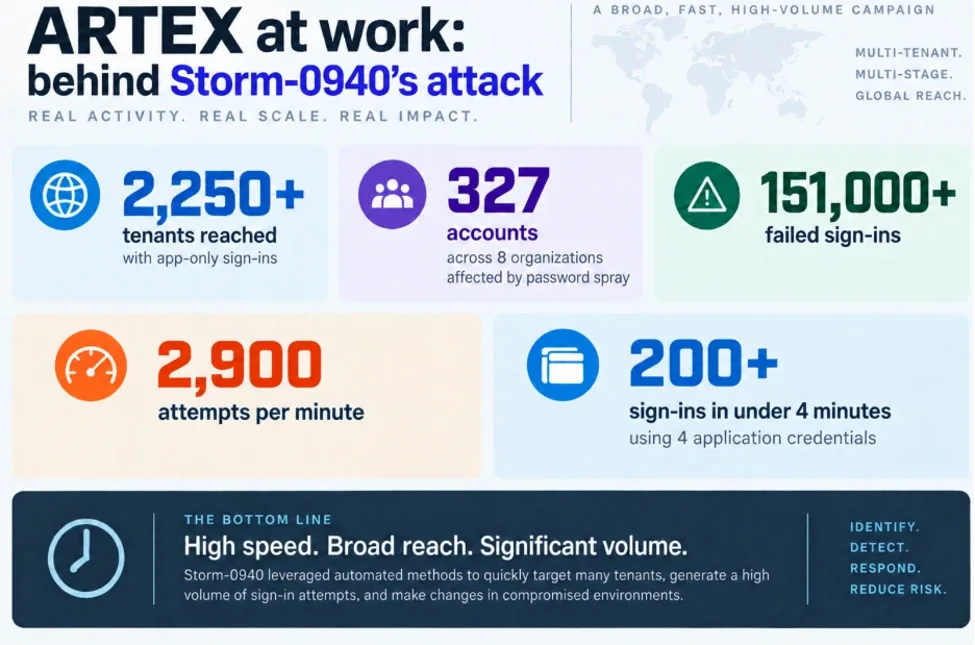
Image: Infographic showing Storm-0940’s high-speed cyberattack: 151,000+ failed sign-ins, reaching 2,250+ tenants and affecting 327 accounts across eight organizations, with over 2,900 attempts per minute and over 200 sign-ins in under 4 minutes using 4 app · Source
The FBI reports hackers using the open-source AI tool Artex to breach networks in under three hours, affecting US IT firm ConnectWise and South Korean financial institutions, accelerating attacks and complicating defense efforts.
The FBI has issued a cybersecurity advisory highlighting the use of an open-source AI-driven hacking tool called Artex in recent cyberattacks targeting multiple sectors globally, including a significant breach of the US IT company ConnectWise and several South Korean financial institutions. Artex is an autonomous penetration testing framework designed to probe network defenses, which hackers have exploited to dramatically speed up their attacks.
Artex operates by integrating with large language models from providers like Anthropic and OpenAI, enabling it to autonomously scan networks, identify vulnerabilities such as weak passwords or exposed credentials, and then exploit these weaknesses to gain unauthorized access. This AI-powered automation allows attackers to move from initial reconnaissance to full network compromise in under three hours, overwhelming traditional human defensive responses which rely on analysis and manual intervention.
According to the FBI, since its public introduction in July 2026, Artex has been implicated in several high-profile incidents. In South Korea, attacks attributed to Artex exploited lacking security measures — including absent multi-factor authentication — resulting in personal data theft from at least 68,000 individuals across financial institutions. In the United States, the FBI and Microsoft identified Artex-associated intrusions into ConnectWise’s cloud backup services, enabling unauthorized access to the Microsoft 365 environments of over 2,250 customers. The hacking group behind these attacks, identified by Microsoft as Storm-0940 and aligned with Chinese state interests, leveraged Artex to automate scanning, password spraying, and OAuth application abuse on a large scale.
The use of Artex allows attackers to generate high volumes of network activity and data logs, which can trigger security alerts. However, the unprecedented speed of the AI automation leaves little time for defenders to detect and remediate breaches effectively. Cybersecurity firm Barracuda reported a related breach where Artex exploited an exposed credential linked to a former vendor, leading to unauthorized access to customer credential stores. Barracuda responded by assuming worst-case exposure and resetting all customer credentials.
In response to its exploitation, the original developer of Artex closed its source code, but the FBI notes that earlier open versions remain widely accessible on the internet, continuing to fuel attacks. Alarmingly, researchers recently discovered hundreds of publicly exposed Artex systems online without password protection, potentially enabling further unauthorized use.
Microsoft advises organizations to implement stringent security protocols such as multi-factor authentication, credential rotation, and ongoing monitoring of service principal sign-ins and Microsoft Graph API activity. They have also introduced tools like the Security Dashboard for AI to monitor AI-related risks in enterprise environments. Given the evolving threat landscape where AI accelerates offensive operations, agencies urge heightened vigilance, focusing on rapid detection, containment, and mitigation to counter the growing challenge posed by AI-driven hacking tools like Artex.
Sources and original reporting
Read the original source ↗
Comments (0)
No comments yet. Start the discussion.
Write a comment
Comments are published after moderation. Your name and comment will be visible publicly. Account