
Google Launches Gemini Decisions API for Fast, Multimodal Choice-Making
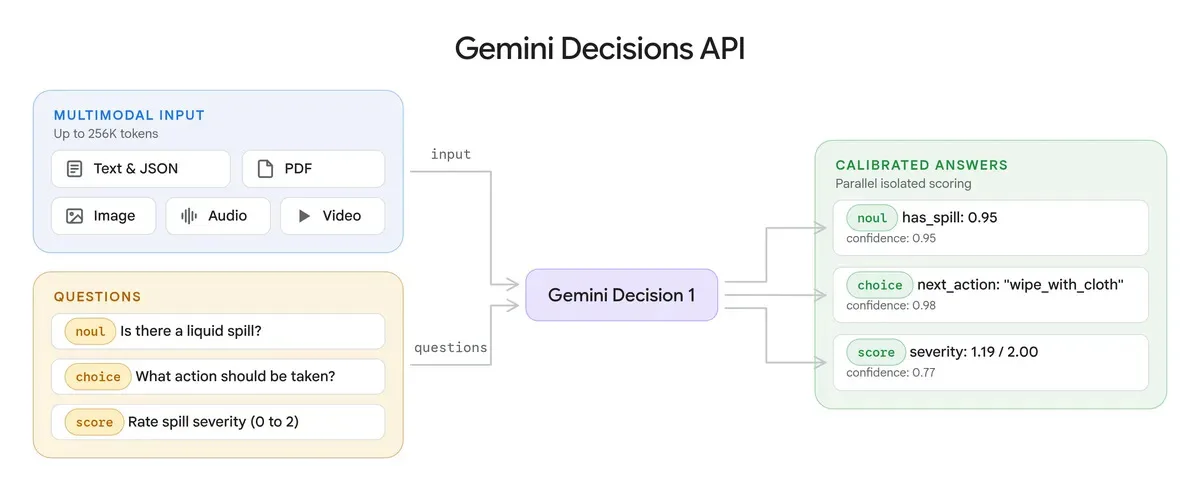
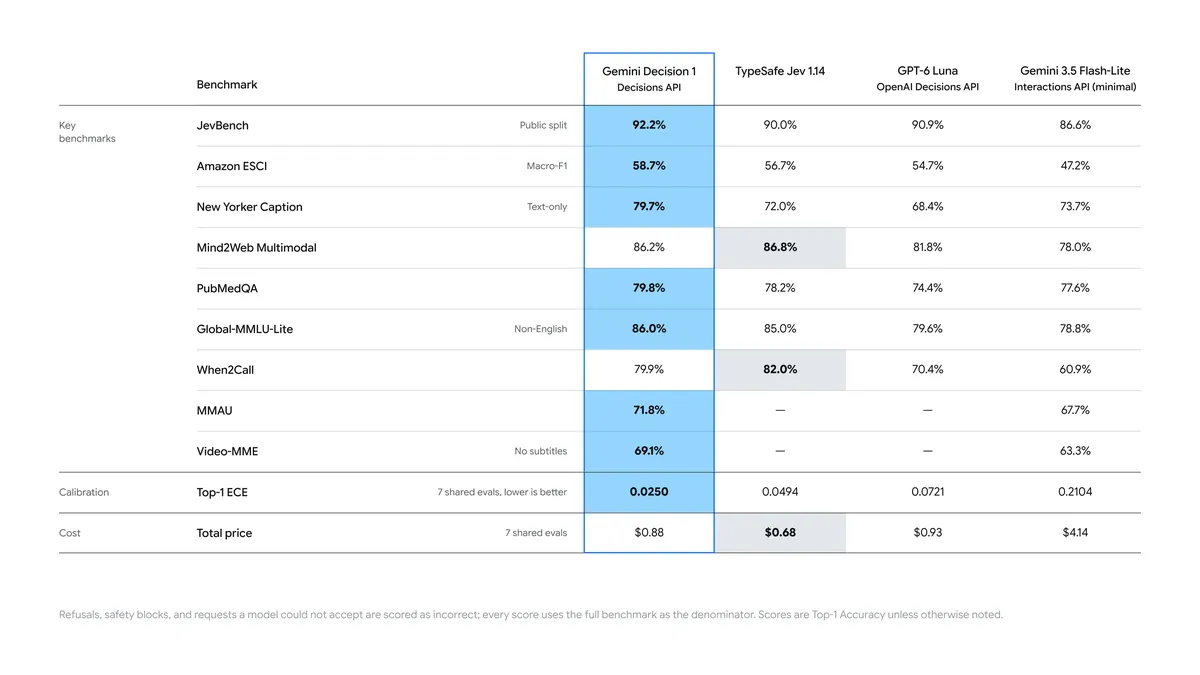
Image: Comparison of Gemini Decision and other APIs against various benchmarks · Source
Google introduces the Gemini Decisions API featuring the Gemini Decision 1 model, enabling quick, calibrated yes/no, multiple-choice, and scoring decisions across text, images, audio, video, and PDFs in a single pass with low latency and cost.
Google has unveiled the Gemini Decisions API, a new tool designed to deliver rapid, calibrated decisions across multiple data types including text, images, audio, video, and PDFs. The API is powered by the latest Gemini Decision 1 model and is accessible through the Gemini API on Google AI Studio.
This technology can process up to 1,000 distinct yes/no, multiple choice, and rubric-scoring questions in a single forward pass of a combined multimodal input, which can include text and media of up to 256,000 tokens. Unlike traditional generative approaches that produce output token by token, Gemini Decision 1 evaluates candidate options simultaneously, yielding confidence scores and probabilities in about 150 to 250 milliseconds end-to-end latency.
According to Google DeepMind product manager Min Choi and principal scientist Felix Yu, this approach offers a highly efficient and cost-effective means to handle large-scale decision-making tasks such as policy compliance checks, content grading, and routing queries. The API charges $0.10 per million input tokens, with no fees for output tokens, making it nearly five times less expensive than previous models like Gemini 3.5 Flash-Lite using the Interactions API.
The Gemini Decisions API supports three decision types: binary yes/no evaluations, multiple-choice selections from 2 to 255 options, and ordered rubric scores that provide weighted continuous results. Developers can combine various input modalities, such as pairing audio call recordings with account information or scanned PDF documents with photos, optimizing the visual resolution to balance detail and token cost.
Multiple Google teams are already employing the API for diverse applications. For example, Gemini Notebook uses it to route queries to the most appropriate AI model tier dynamically, improving latency by up to 40%. The design tool Stitch integrates the API for rapid product flow wireframe generation with near real-time editing, and the Google Labs app CC utilizes it for instant emoji reaction selection. Furthermore, Google Search applies the API as a safety layer to detect adversarial content efficiently within strict latency constraints.
Developers can start using the Gemini Decisions API immediately by obtaining an API key from Google AI Studio, where documentation and sample applications are available in Python, JavaScript, and REST formats. The API also integrates with several popular ecosystems and platforms, including OpenRouter, LangChain, Vercel, LiteLLM, and more, with forthcoming support for Gemini in Google Cloud.
This release reflects Google's continuing emphasis on scalable, low-latency AI tools that can evaluate complex, multimodal inputs rapidly, enabling more responsive and intelligent applications across industries.

Sources and original reporting
Read the original source ↗
Comments (0)
No comments yet. Start the discussion.
Write a comment
Comments are published after moderation. Your name and comment will be visible publicly. Account