
NVIDIA DGX Spark 64GB: A Practical Local AI Platform for Developers and Researchers
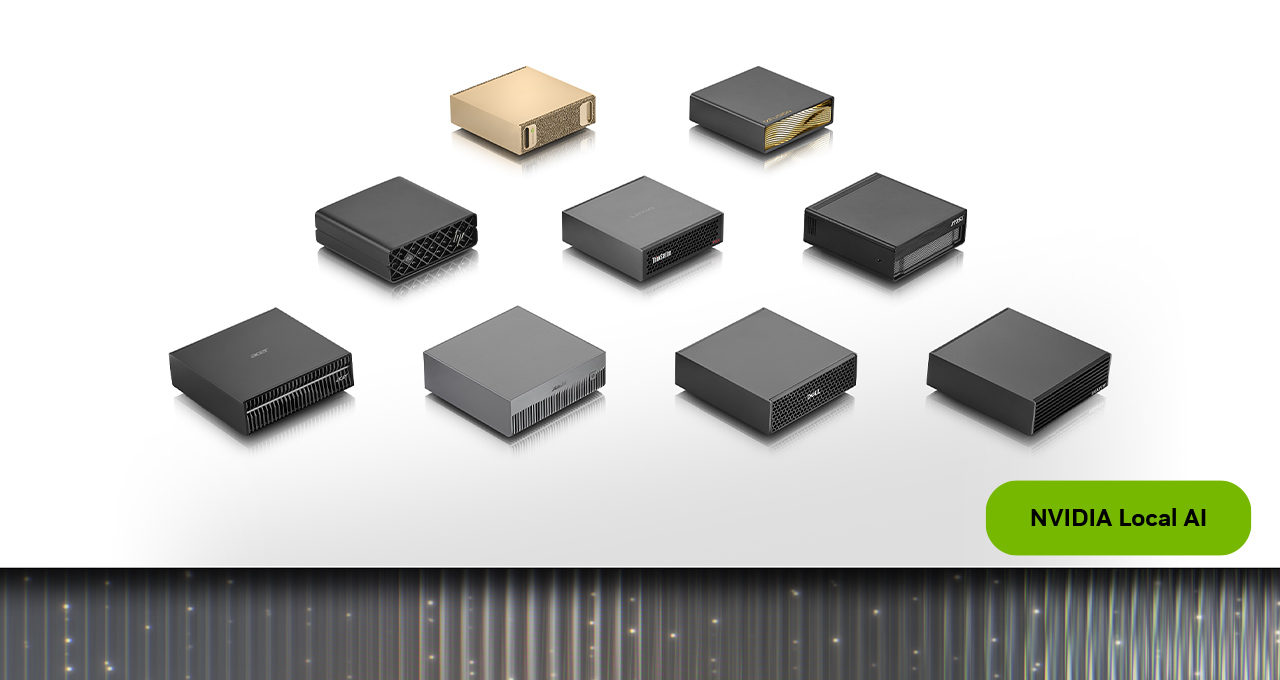
Image: NVIDIA · Source
The NVIDIA DGX Spark 64GB offers a compact, scalable local AI supercomputing solution, enabling deployment and scaling of agentic AI models up to 100 billion parameters on-device. It supports seamless multi-node clustering and comes preloaded with NVIDIA's AI software stack for immediate productivity.
Introduction to NVIDIA DGX Spark 64GB
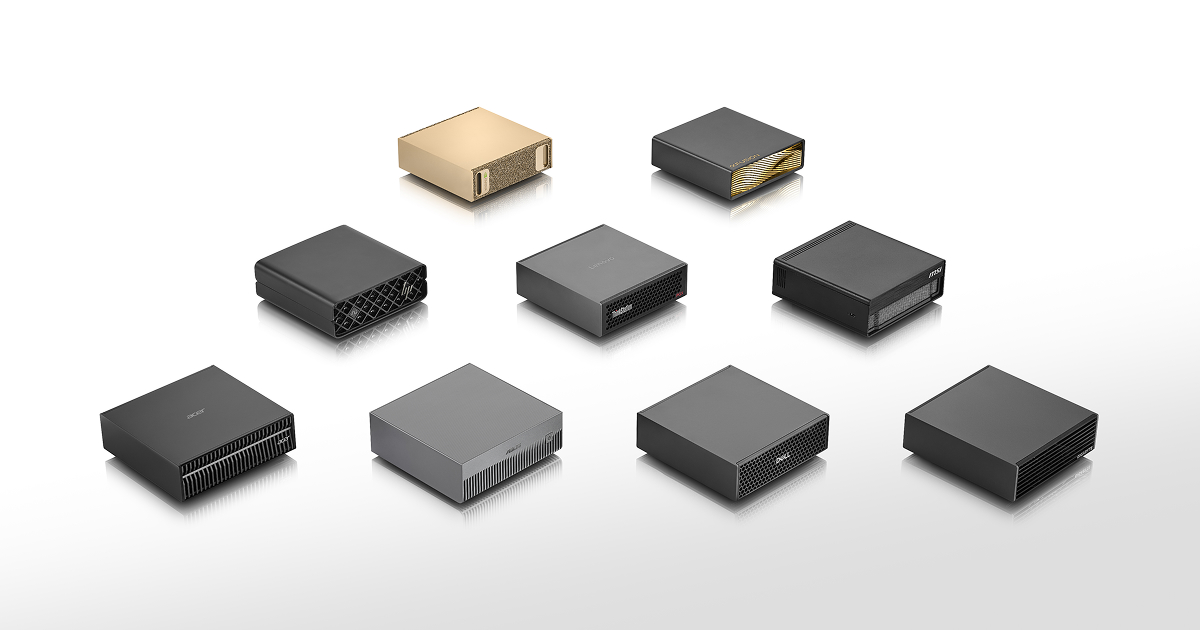
The NVIDIA DGX Spark 64GB is a specialized local AI computing platform designed to empower AI developers, researchers, and enthusiasts by providing powerful, private, and scalable AI capabilities on-premises. Developed in partnership with leading hardware providers such as Acer, ASUS, Dell, Gigabyte, HP, and MSI, this platform integrates advanced hardware and software optimized for agentic AI applications, inference, fine-tuning, and data science tasks.
With 64GB of unified memory and the NVIDIA Grace Blackwell Superchip at its core, the DGX Spark 64GB supports running substantial language models—up to 100 billion parameters directly on the device—without reliance on cloud infrastructure. This capability meets growing demands for local AI computation with privacy and latency advantages.
Architectural and Hardware Overview
At the heart of the DGX Spark 64GB is the NVIDIA GB10 Grace Blackwell Superchip, an architecture tailored to optimize AI workloads with a focus on unified memory design. The 64GB unified memory allows large models to be loaded entirely in memory, reducing data movement overhead and accelerating inference and fine-tuning tasks.
Networking is facilitated by the integrated NVIDIA ConnectX-7 NIC, which supports up to 200 Gigabit Ethernet, enabling high-throughput, low-latency connections for clustering multiple DGX Spark units. This combination of processing power, memory, and networking hardware positions the device as a compact yet capable personal AI supercomputer.
The platform runs DGX OS, NVIDIA’s specialized operating system for AI workloads, and incorporates an AI software stack optimized with CUDA-X AI libraries and support for widely used frameworks. This integration ensures out-of-the-box acceleration for PyTorch, Ollama, vLLM, and other runtimes along with access to open large language models such as Nemotron.
Scalability Through NVIDIA Sync Cluster Assistant
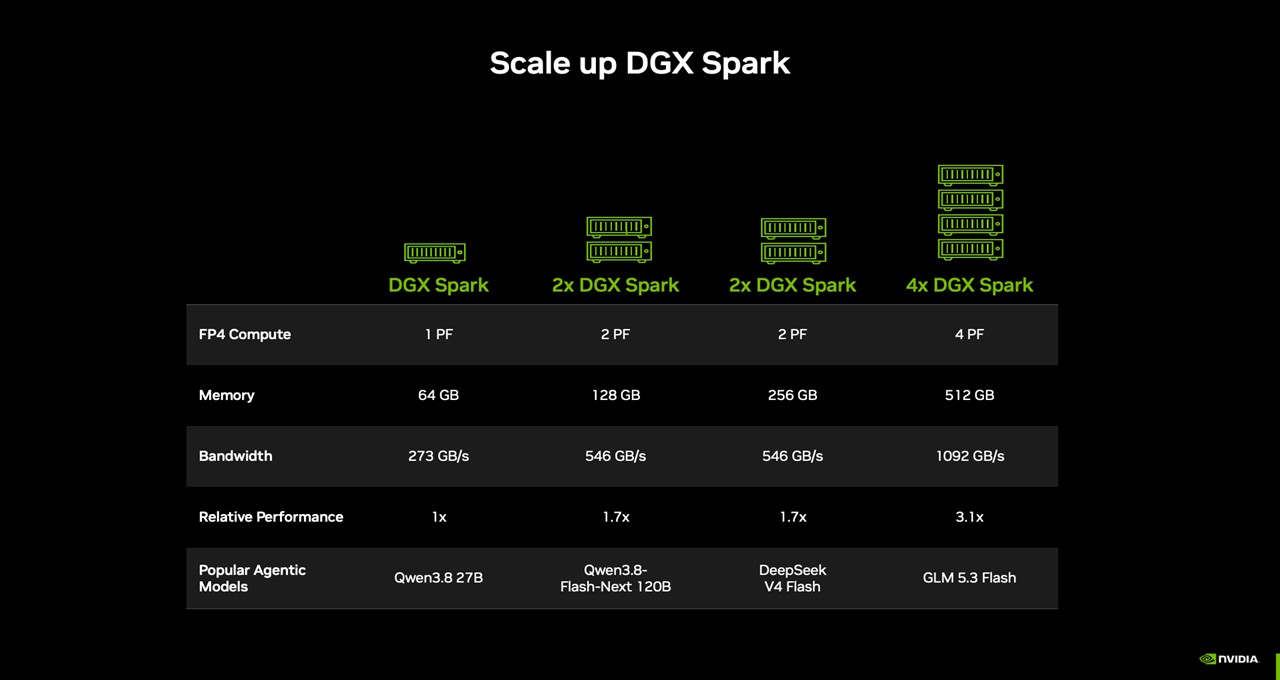
A key innovation of the DGX Spark 64GB is its seamless scalability enabled by NVIDIA Sync Cluster Assistant. This software orchestrates the clustering of two DGX Spark units over their ConnectX-7 NICs via a QSFP cable without requiring manual network or software configuration.
Pooling the two 64GB units yields 128GB of unified memory, effectively enabling the running of models up to 200 billion parameters and delivering up to 1.7 times the performance of a single unit. NVIDIA’s internal testing with the Qwen 3.8 27B model indicates genuine performance and capacity scalability beyond mere memory doubling.
The Sync Cluster Assistant automatically detects connected nodes, validates device status, and configures the network, simplifying the transition from single-node to multi-node environments. Uniform software stacks across nodes mean developers do not need to adjust deployments when scaling.
Software Stack and Developer Tooling
DGX Spark comes pre-installed with an extensive NVIDIA AI software ecosystem designed to expedite AI development:
- **NVIDIA Agent Toolkit:** Supports local autonomous AI agents performing complex and multistep tasks.
- **CUDA-X AI Libraries:** Deliver GPU-accelerated performance for AI workloads including training and inference.
- **Open Large Language Models:** Includes access to models like Nemotron for immediate deployment or fine-tuning.
- **Supported Runtimes:** Compatibility with popular runtimes such as Ollama, vLLM, llama.cpp, and PyTorch with CUDA, offering flexibility to developers.
- **Upcoming NVIDIA Sync Model Launcher:** A graphical interface anticipated to simplify launching large models such as Qwen 3.8 27B on single or clustered units, while managing distributed model execution and access from laptops.
This comprehensive toolset allows users to shift rapidly from hardware setup to productive AI application development.
Example Workflow 1: Running a Persistent AI Agent for Coding and Research
**User:** Software developers or researchers needing ongoing AI support for code review, document analysis, or complex task automation.
**Prerequisites:** One DGX Spark 64GB with NVIDIA Agent Toolkit.
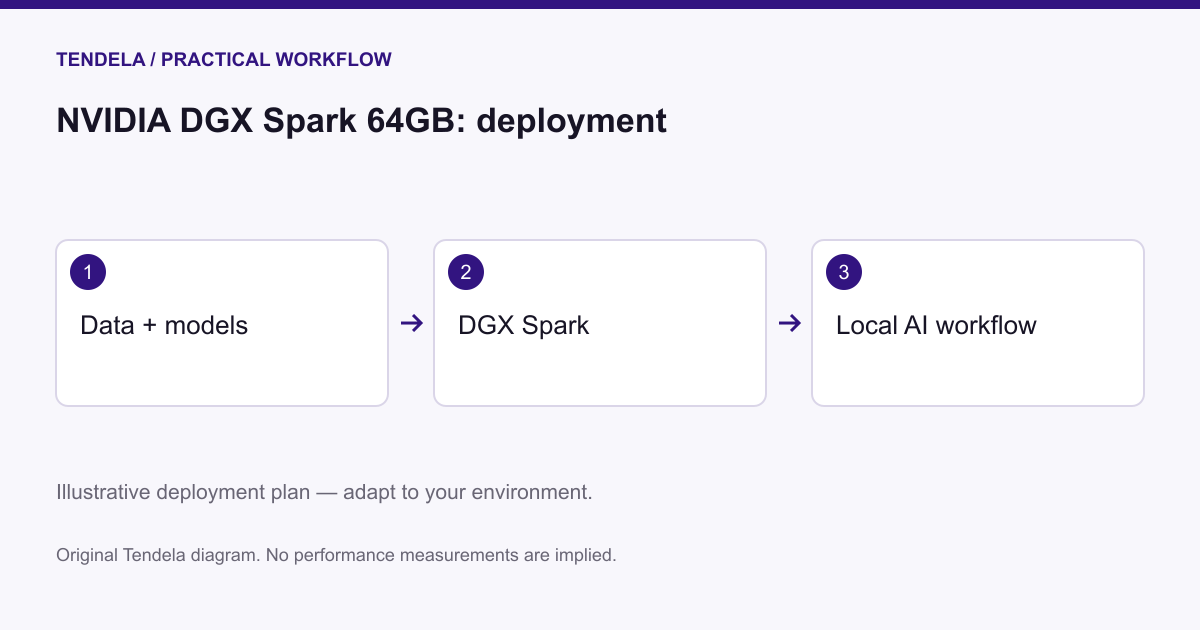
**Steps:** 1. Power on the DGX Spark and access the preloaded NVIDIA AI software stack. 2. Deploy an autonomous AI agent tailored to code or document analysis using the Agent Toolkit. 3. Integrate relevant datasets or project files into the agent’s environment. 4. If demands increase, cluster a second DGX Spark 64GB with NVIDIA Sync Cluster Assistant to increase capacity and run multiple concurrent agents.
**Successful Outcome:** A continuously running local AI agent capable of assisting users in real-time without reliance on cloud services, benefiting workflows requiring privacy and low latency.
**Considerations:** Thermal management and power supply adequacy are critical for sustained operation. Model size must align with available memory, scaling accordingly.
Example Workflow 2: Supporting AI-Powered Creative Applications on User PCs
**User:** Graphic designers or creative professionals who want to perform resource-intensive AI inference without burdening their personal computers.
**Prerequisites:** DGX Spark accessible on local network; client devices running compatible creative software.
**Steps:** 1. Host AI inference models (for example, text-to-image or language models) on DGX Spark. 2. From user workstations, access these models via APIs or integration layers. 3. Utilize forthcoming Blender prebuilt installer to directly employ DGX Spark AI features within creative workflows.
**Successful Outcome:** AI model inference is performed on DGX Spark, offloading compute demand from client PCs, improving responsiveness and enabling more complex AI-supported creative tasks.
**Considerations:** Network reliability and bandwidth can impact interactivity; secure authentication and data transfer strategies should be enforced.
Example Workflow 3: Scaling AI Workloads with Growing Demands
**User:** AI researchers or small enterprises starting with medium-scale tasks but anticipating needs for larger models or concurrent inferences.
**Prerequisites:** Two DGX Spark 64GB units interconnected using QSFP cables.
**Steps:** 1. Start with a single DGX Spark 64GB system for baseline AI workloads. 2. Add a second unit and connect them via their ConnectX-7 NICs. 3. Use NVIDIA Sync Cluster Assistant to detect, configure, and verify the multi-node cluster. 4. Seamlessly scale AI workloads leveraging doubled unified memory and accelerated inter-node communication without modifying existing software stacks.
**Successful Outcome:** Enhanced capacity to accommodate larger models, extended context windows, or multiple simultaneous AI tasks.
**Considerations:** Current scaling is limited to two physical nodes; software licensing and network configurations must conform to NVIDIA’s documented guidelines.
Example Workflow 4: Edge AI Development and Fine-Tuning
**User:** Data scientists and AI developers working on edge AI applications that require on-device model fine-tuning and inference without cloud dependency.
**Prerequisites:** A DGX Spark 64GB system with DGX OS and access to datasets for fine-tuning.
**Steps:** 1. Deploy initial base models that fit within the 64GB unified memory. 2. Utilize NVIDIA CUDA-X AI libraries and PyTorch with CUDA to perform fine-tuning tasks locally. 3. Test model deployments on edge devices by simulating real-time inference conditions using the local DGX Spark. 4. For scalability, link a second DGX Spark 64GB with the Sync Cluster Assistant to handle more complex models or multiple concurrent edge application simulations.
**Successful Outcome:** Developers can quickly iterate on model design and deployments with low latency feedback cycles, maintaining complete control over data and models.
**Considerations:** Dataset size and model complexity must remain within the memory constraints unless scaling with multi-node clusters. Developers should verify latency and real-time responsiveness meet application requirements.
Compatibility, Maintenance, and Security Considerations
Maintaining a consistent software and hardware environment across DGX Spark units aids reliability and simplifies updates. Organizations should incorporate security best practices to protect sensitive data and infrastructure when deploying local AI clusters.
Backups of data, models, and configurations remain user responsibilities. Regular monitoring of hardware health and predictive maintenance supports uptime and system longevity.
Network segmentation and firewalls are recommended to safeguard the devices when integrated into broader IT environments. Users should consult NVIDIA documentation for detailed procedures and compliance guidelines.
The platform supports leading AI frameworks and runtimes to ensure broad compatibility, but users must verify specific integrations with their chosen software tools.
Product Fit and Limitations
The NVIDIA DGX Spark 64GB is ideal for AI professionals needing a powerful, compact local AI computing platform with scalable options. Its architecture suits confidential data handling, iterative AI agent development, and workloads requiring immediate local inference.
It is less appropriate for extremely large-scale distributed AI tasks exceeding two-node clusters or those requiring hundreds of billions of parameters. Additionally, organizations with very tight budgets or limited physical space may find the solution less manageable.
The upfront cost and manufacturer-specific hardware configurations dictate evaluation aligned with organizational needs and infrastructure.
Conclusion
The NVIDIA DGX Spark 64GB provides a well-integrated, scalable, and efficient platform for local AI model development and deployment. Combining advanced CPU-GPU architecture, substantial unified memory, and streamlined clustering via NVIDIA Sync simplifies the adoption and scaling of agentic AI workloads entirely on-premises.
Preloaded software stacks and broad framework support enable immediate developer productivity, while multi-node clustering options accommodate growth in AI workload complexity.
This review is based exclusively on official NVIDIA product documentation and blog posts dated October 2026, offering a feature and workflow analysis without independent hands-on evaluation or third-party benchmarking.
Sources and original reporting
Read the original source ↗
Comments (0)
No comments yet. Start the discussion.
Write a comment
Comments are published after moderation. Your name and comment will be visible publicly. Account