
Cloudflare Zero Trust: Practical Review of Cloudflare's SASE Platform for Enterprise Security and Networking
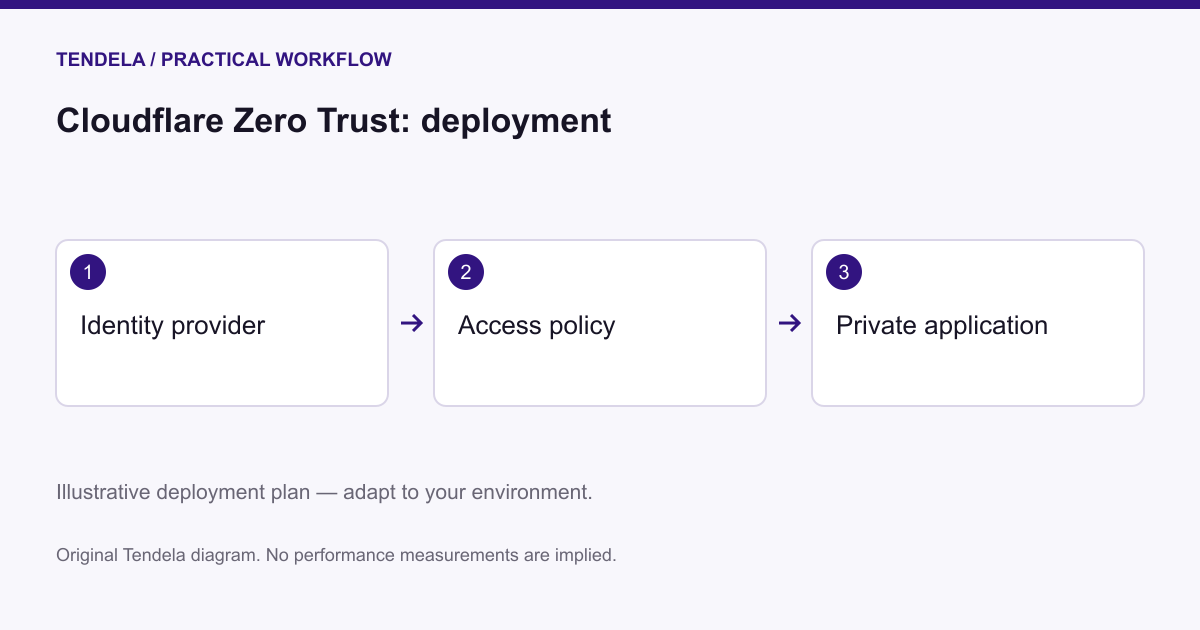
Image: Tendela / illustrative workflow · Source
Cloudflare Zero Trust unifies security and networking through Cloudflare One, a Secure Access Service Edge (SASE) platform delivering identity-based access controls, threat protection, and network connectivity overlay across distributed enterprises.
Introduction to Cloudflare Zero Trust
Cloudflare Zero Trust is a cloud-delivered Secure Access Service Edge (SASE) platform branded as Cloudflare One. It is designed to replace traditional network perimeters with a globally distributed, identity-aware security framework. This platform implements Zero Trust security principles, which assume no implicit trust inside networks and require every request to be authenticated and authorized based on user identity and device context. Cloudflare One consolidates multiple network and security functions on a unified control plane, managed through Cloudflare's dashboard interface.
Core Architectural Model: SASE and Zero Trust
Secure Access Service Edge (SASE) merges wide-area networking (WAN) with security services into a single cloud-delivered platform. This architecture addresses challenges arising from distributed workforces and cloud services adoption. Cloudflare One exemplifies SASE by integrating secure access, threat protection, and network connectivity performed at Cloudflare’s global edge network.
Zero Trust enforces the principle of least privilege by continuously authenticating identity and evaluating device posture before granting access. Unlike traditional perimeter security models that trust users once logged in, Zero Trust assumes threats could originate both outside and inside the network and requires verification on every access attempt.
Key Components of Cloudflare One
Cloudflare One consists of multiple interconnected products, each addressing specific enterprise security or networking needs:
Cloudflare Access allows secure authentication into web applications, integrating with identity providers to control access.
The Secure Web Gateway (Gateway) inspects and filters outbound traffic at DNS, network (Layer 4), and HTTP (Layer 7) layers. It enforces policies such as URL filtering, malware scanning, and data loss prevention.
Cloudflare Tunnel establishes outbound-only connections from private infrastructure to Cloudflare’s global network, eliminating the need to expose public IP addresses.
Cloudflare Mesh enables encrypted mesh networking between devices and private networks, utilizing post-quantum cryptography methods according to Cloudflare's documentation.
Remote Browser Isolation executes browser code remotely in the cloud to isolate risks from unsafe web content.
Data Loss Prevention (DLP) scans web traffic and SaaS applications for sensitive data patterns to prevent leaks.
Cloud Access Security Broker (CASB) monitors SaaS and cloud environments for misconfigurations, insider threats, and unsanctioned application usage.
Email Security provides policy configuration for mailbox management and threat investigation.
Digital Experience Monitoring (DEX) tracks network, device, and application performance within the Zero Trust environment.
Cloudflare WAN and the Cloudflare Network Firewall offer cloud-native networking services intended to provide alternatives to legacy WAN technologies like MPLS and traditional SD-WAN, as well as firewall-as-a-service capabilities.
These components operate across Cloudflare’s extensive network of globally distributed data centers to provide low latency and scalable security enforcement.
Traffic Policies and Security Layers
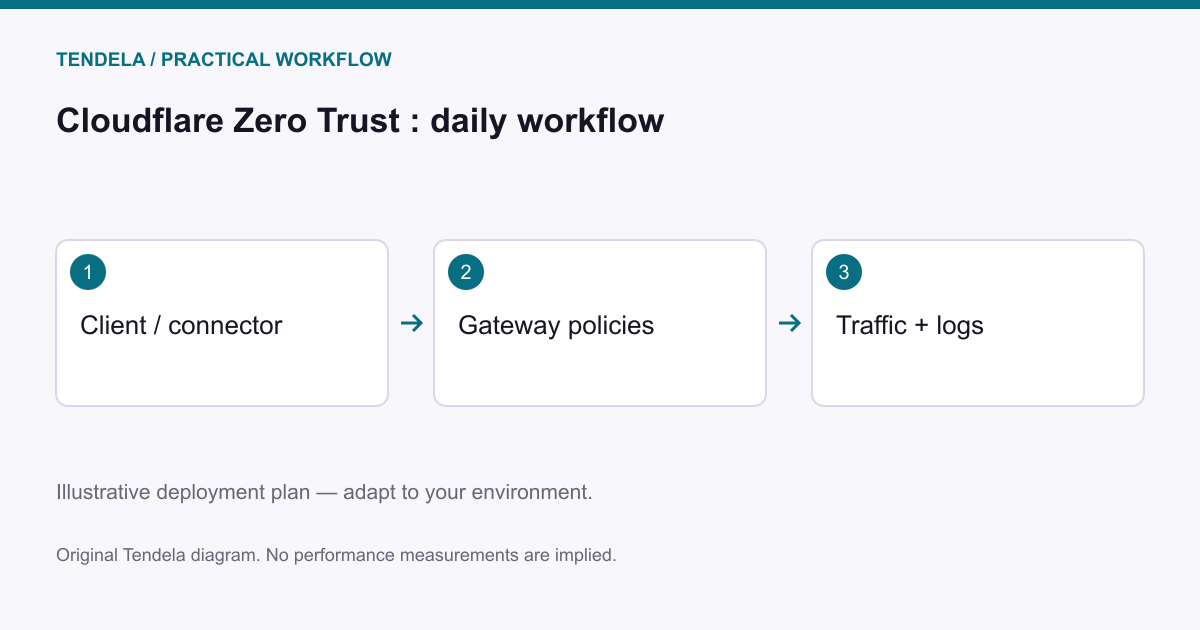
The Secure Web Gateway supports multiple policy layers for traffic inspection:
Packet Filtering inspects raw network packets based on IP addresses, ports, and protocols without user or application context, enabling early drops of unwanted traffic.
DNS Policies block unwanted or malicious domains by intercepting DNS queries before connections are established, allowing rapid policy enforcement.
Network Policies control individual TCP, UDP, or GRE packets and can block access to particular services like SSH or RDP.
HTTP Policies decrypt and inspect HTTPS traffic requiring installation of a Cloudflare root certificate on managed devices. These policies scan URLs, headers, uploaded or downloaded files for malware and sensitive content, and can quarantine suspicious files.
Policies are enforced in sequence—DNS first, then network, followed by HTTP—allowing layered defense against threats.
Identity and Device Context Integration
Cloudflare One integrates with identity providers such as Okta, Microsoft Entra ID, and Google Workspace as examples to retrieve user identities and group memberships. The Cloudflare One Client installed on user devices gathers device posture signals including operating system version, disk encryption status, firewall state, and management status.
Administrators can create access policies combining identity and device context, allowing fine-grained control. For instance, access to sensitive applications can require both membership in a specific user group and compliance with device security requirements such as disk encryption.
Deployment Considerations and On-Ramp Options
Cloudflare provides several on-ramp connection methods influencing what policy types can be enforced:
The Cloudflare One Client (WARP) agent is the recommended method for per-device deployments, enforcing DNS, network, and HTTP policies with full visibility.
DNS resolver configuration changes DNS settings on routers or devices to enforce DNS policies only, suitable for unmanaged devices or initial rollouts.
Proxy endpoints configured via PAC files enable HTTP traffic inspection at the browser level without installing agents, but are limited to browser traffic and do not support device-level visibility.
Network tunnels (IPsec/GRE via Magic WAN) connect branch offices or data centers, enabling policy enforcement across all layers for site-level traffic.
Organizations commonly deploy a combination of these methods to protect different user segments effectively.
Example Workflow 1: Securing Remote Workers' Access to Internal Applications
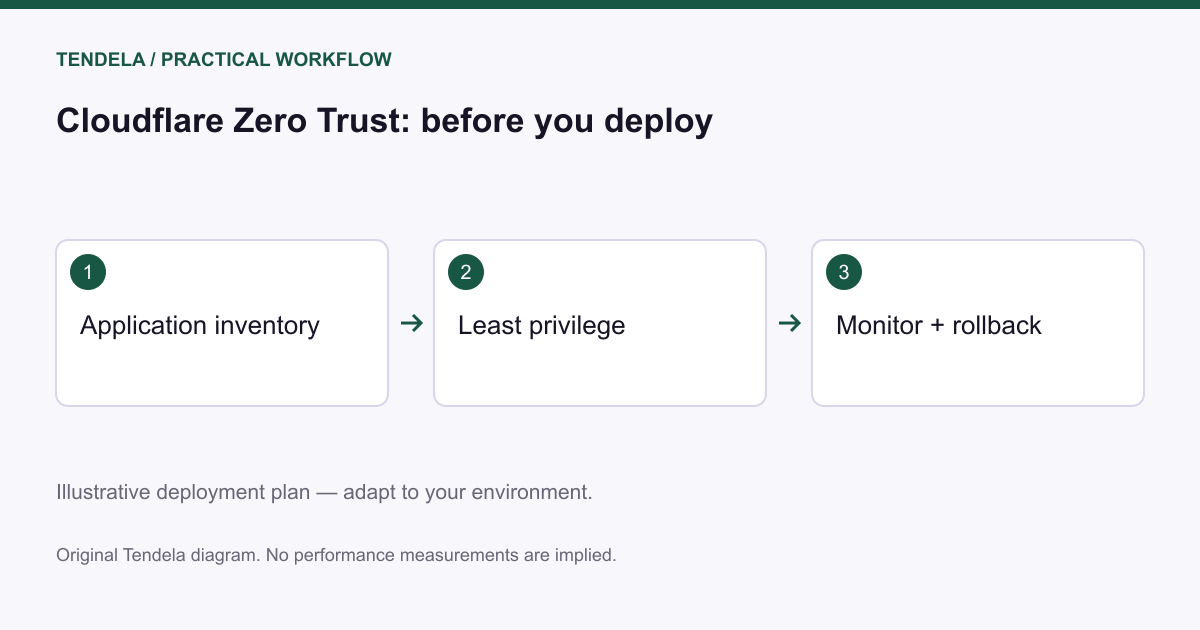
In this workflow, remote employees require secure access to internal web applications without exposing those apps publicly.
First, the Cloudflare One Client is deployed to remote user devices to route and inspect traffic.
Cloudflare Access is configured with identity provider integration to authenticate users and enforce group memberships.
Cloudflare Tunnel is deployed to connect internal applications securely to Cloudflare's edge network with outbound-only connections, preventing public IP exposure.
Access policies incorporate identity and device posture checks, ensuring only compliant devices and authorized users reach internal resources.
Success criteria include seamless single sign-on access to internal apps, absence of public IP exposure on internal resources, enforcement of device compliance policies, and comprehensive logging for audit purposes.
Limitations to verify include device compatibility with the Cloudflare One Client, correct identity provider setup, and troubleshooting connectivity for various remote environments.
Example Workflow 2: Enforcing Acceptable Use and Malware Protection for Corporate Web Traffic
Corporate users need safe internet access with filtering of malicious sites and monitoring of browsing activity.
Users are enrolled via the Cloudflare One Client or connected through network tunnels to route traffic to Cloudflare Gateway.
Administrators configure DNS policies to block access to known malware domains and unwanted content categories promptly.
HTTP policies are added to perform deep packet inspection including URL filtering, malware scanning of downloads, and quarantining suspicious files.
Traffic policies can differentiate user groups for specific rules, such as more restrictive policies for contractors.
Successful deployment results in effective blocking of malicious and unauthorized content, minimal latency impact, and granular visibility into user activity and threats.
Constraints include ensuring installation of Cloudflare root certificates on managed devices to enable HTTPS decryption, consideration of privacy and compliance impacts for decrypted traffic, and awareness that policy changes may take up to 60 seconds to propagate globally.
Example Workflow 3: Connecting and Securing Branch Offices with Cloudflare WAN
For organizations seeking to replace legacy WAN technologies such as MPLS or traditional SD-WAN, Cloudflare WAN provides an overlay network service.
Cloudflare-managed hardware or virtual appliances are deployed at branch locations and data centers.
IPsec or GRE tunnels are established between these devices and Cloudflare's global network.
Routing policies connect branches, data centers, and cloud resources securely through this overlay.
Centralized firewall policies are applied via the Cloudflare dashboard, enforcing consistent security controls across locations.
Intended benefits include scalable and unified WAN connectivity and integrated security services managed through a single platform.
Planning considerations involve selecting appropriate appliance models for required throughput, validating network routing configurations, and designing for redundancy and failover.
Maintenance and Security Boundaries
Cloudflare's platform operates and maintains the global infrastructure components of Cloudflare One. Customer responsibilities include managing policy configurations, identity provider integrations, and endpoint software updates such as the Cloudflare One Client and root certificates.
Ensuring strong identity governance and device compliance is vital to secure the environment. Misconfigurations in policies or identity integrations may introduce security gaps.
Administrators should establish monitoring and alerting mechanisms using Cloudflare's logging and digital experience monitoring tools to maintain operational security.
Suitability and Fit
Cloudflare Zero Trust via Cloudflare One is well suited for organizations seeking to modernize away from legacy perimeter-based security toward scalable, cloud-delivered, identity and device context-aware architectures. It supports securing dispersed workforces, multiple cloud applications, and branch office networking with centralized management.
Organizations heavily reliant on offline capabilities or complex on-premises legacy systems may find limitations, and should evaluate integration requirements carefully.
Conclusion
Cloudflare Zero Trust delivers a comprehensive, unified SASE platform that integrates identity-centric access, multi-layer traffic inspection, and network connectivity overlay suitable for modern enterprises. It enables securing remote users, protecting branches, and enforcing detailed, context-aware policies via a global cloud infrastructure.
This review is based exclusively on Cloudflare's official documentation and reference materials as of 2026, without conducting hands-on testing or independent performance benchmarks.
Sources and original reporting
Read the original source ↗
Comments (0)
No comments yet. Start the discussion.
Write a comment
Comments are published after moderation. Your name and comment will be visible publicly. Account