
Generative AI Fuels Southeast Asia’s Digital Economy Toward $1 Trillion by 2035

Image: Google · Source
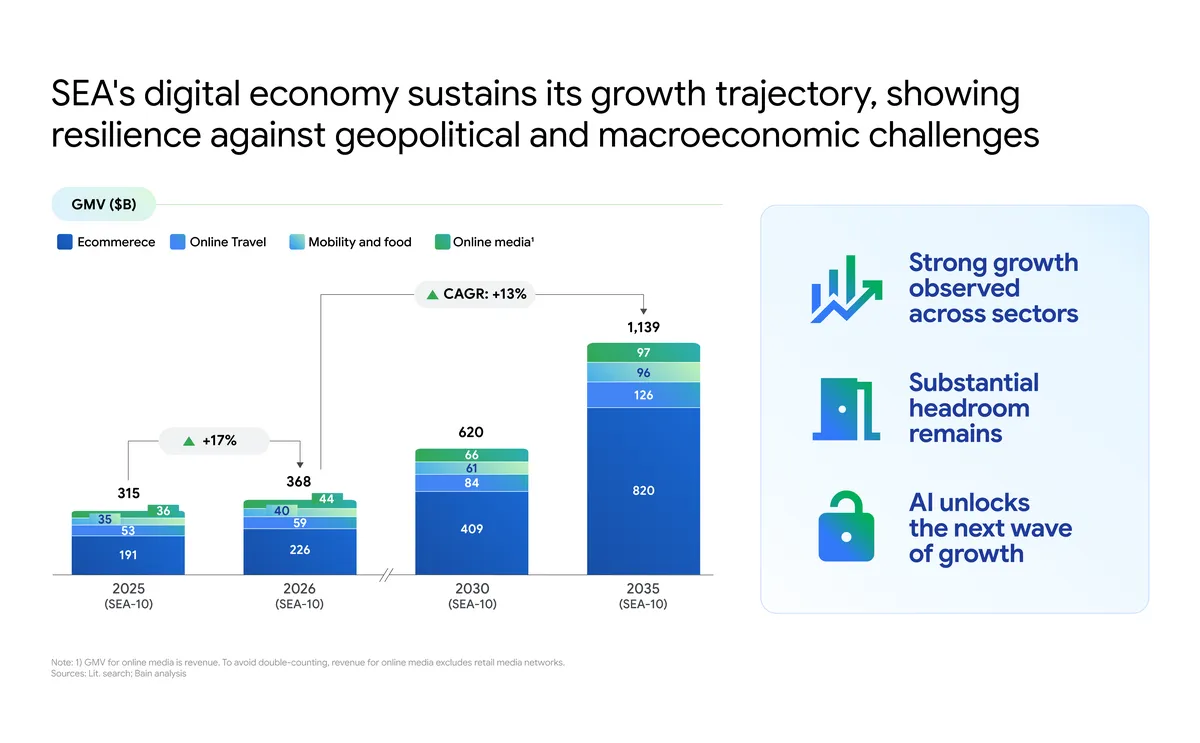
Southeast Asia's digital economy is projected to reach $368 billion in 2026 and $1 trillion by 2035, driven by rapid adoption of generative AI across sectors and growing consumer trust in agentic commerce.
Southeast Asia's digital economy is rapidly expanding, bolstered significantly by the widespread adoption of generative artificial intelligence (AI). According to the 11th annual e-Conomy SEA report by Google, Temasek, and Bain & Company, the region’s digital Gross Merchandise Value (GMV) is expected to reach $368 billion in 2026, growing at an impressive 17% year-on-year. This growth trajectory sets the digital economy on course to surpass a staggering $1 trillion valuation by 2035.
Generative AI usage in Southeast Asia is scaling four times faster than the mobile internet rollout did, currently engaging 243 million people, or 58% of the working population. This transformative technology is reshaping multiple sectors including e-commerce, online travel, digital media, mobility, food delivery, and digital financial services. For instance, AI-powered shopping assistants are enabling personalized, multimodal discovery experiences that increase online shopping conversions by 10% and can boost order volumes by as much as 75%. In travel, generative AI has become the second-most used tool for complex itinerary planning, surpassing social media.
Consumer trust in AI is strong across the region, with 62% of users reporting increased confidence in AI tools over the past year. This solid trust underpins the rise of "agentic commerce," where AI agents autonomously compare prices and complete purchases on behalf of consumers. About 75% of Southeast Asians indicate willingness to delegate such tasks to AI, provided there are clear privacy protections, transparency about AI capabilities, and mechanisms to reverse transactions if needed.
To sustain this rapid AI-driven expansion, Southeast Asia faces four critical challenges. First, businesses must evolve AI applications from simple queries toward completing multi-step transactions autonomously, while maintaining rigorous privacy and safety standards. Second, physical infrastructure requires a threefold increase in data center capacity over the next five years, with AI workloads becoming dominant. Third, energy efficiency and strict regulatory frameworks, like Singapore's Digital Infrastructure Bill, are essential to ensure sustainable AI operations. Fourth, regional governance will be strengthened by the upcoming ASEAN Digital Economy Framework Agreement in November 2026, the world’s first comprehensive digital trade pact, which aims to unify policies and accelerate cross-border digital growth.
Overall, generative AI is not only driving impressive economic growth but also catalyzing a fundamental shift in how people across Southeast Asia live, shop, travel, and manage finances. With ongoing infrastructure investments and regulatory advancements, the region is poised to lead the next wave of the global digital economy.


Sources and original reporting
Read the original source ↗
Comments (0)
No comments yet. Start the discussion.
Write a comment
Comments are published after moderation. Your name and comment will be visible publicly. Account